
If you have ever noticed your cat making a beeline for the highest surface in any room - the top of the wardrobe, the fridge, the bookshelf - and wondered what the appeal is, you are observing something much older and more deeply wired than mere curiosity. The preference for height in domestic cats is not a quirk. It is an expression of territorial instinct that has been present across the Felidae family for millions of years, and it shapes your cat's sense of security, social position, and emotional wellbeing in ways that play out daily in your home.
Understanding why vertical space matters is one of the most practical things a cat owner can do. It directly informs what kind of environment your cat needs to feel settled, what furniture choices make a real difference, and why some behavioural problems in cats - particularly in multi-cat households - have spatial causes rather than personality ones.
At Cat Tree Haven, we work with Australian cat owners who are often surprised by how much of their cat's day-to-day behaviour comes back to the question of territory, and how much of that is about height. Here is what the research and the practical experience both point to.
Cats Are Territorial in Three Dimensions
Most people think of territory in horizontal terms - a patch of floor space, a room, a section of garden. But feline territory is three-dimensional. Cats lay claim to vertical zones just as meaningfully as they claim physical ground, and the rules of vertical territory are distinct from those of horizontal space.
In the wild, wild cats and their ancestors used height for two overlapping purposes. First, an elevated position offers a vantage point from which to monitor the surrounding environment - to spot prey, identify threats, and assess what is happening without the vulnerability of being at ground level. Second, height functions as a social signal. In multi-cat environments, the individual with access to the highest perch is communicating status. Occupying the top position in a physical space is a form of social assertion that does not require physical confrontation.
Domestic cats have retained both of these functions almost entirely intact. A cat that climbs to the highest available point in your living room is doing exactly what their wild relatives do - surveying their territory from a position that feels secure and communicating, in a language older than words, that this space belongs to them.
The implication of this is important: horizontal floor space and vertical space are not interchangeable in a cat's territorial experience. Adding more floor space to a cat's environment does not meet the same need that vertical space does. A cat who has the run of a large apartment but no elevated perches is working with a territorially incomplete environment.

What Height Does for a Cat's Nervous System
The sense of security that cats derive from height is not metaphorical. It is physiological. An elevated position reduces a cat's exposure to sudden threats from below, limits the directions from which they can be approached, and gives them advance warning of anything entering their space. For a species that spent millions of years managing the risk of predation alongside its own predatory behaviour, this matters.
Dr Mikel Delgado, a certified feline behaviour consultant, has noted that for cats, height functions as safety - being up high reduces the likelihood of being surprised by a threat, whether that is another animal, a child, a dog, or an unfamiliar person. The height is not just a preference; it is a stress-management mechanism.
When a cat feels that its environment lacks safe elevated retreat points, this can manifest as increased baseline anxiety. Cats in environments without adequate vertical options may spend more time hiding at ground level, avoid rooms where they feel exposed, or become more reactive to household noise and movement. These are not personality traits - they are adaptive responses to an environment that does not meet a core security need.
The reverse is also observed: cats provided with consistent, reliable elevated spaces tend to be calmer, more confident, and more socially engaged. They have somewhere to retreat to that feels safe, which means they do not need to stay constantly vigilant at ground level.
The Multi-Cat Household: Where Vertical Space Becomes Critical
The territorial importance of height becomes most immediately practical in households with more than one cat. This is where the absence of adequate vertical space translates most directly into observable behavioural problems.
Research published in Applied Animal Behaviour Science found that cats given access to vertical shelving showed a significant decrease in agonistic (conflict-related) behaviour. The mechanism is straightforward: vertical space expands the usable territory available to each cat without requiring any additional floor area. When two cats can occupy genuinely different levels of a space - one high, one mid, one low - they are not directly competing for the same territory. When all cats are limited to ground level and the same horizontal surfaces, competition becomes unavoidable.
In practical terms, this means inter-cat conflict in multi-cat homes is often at least partly a resource conflict, and vertical space is one of the key resources involved. Cats that appear to dislike each other, engage in chasing behaviour, guard doorways, or stress-eat may in some cases be expressing frustration at having insufficient separate territory rather than a fundamental incompatibility with each other.
Adding meaningful vertical territory - particularly structures with multiple distinct levels at different heights - can reduce this competition by giving each cat a separate spatial zone to claim. The dominant cat will often take the highest position, which is precisely as it should be: they are expressing status without needing to physically displace another cat.
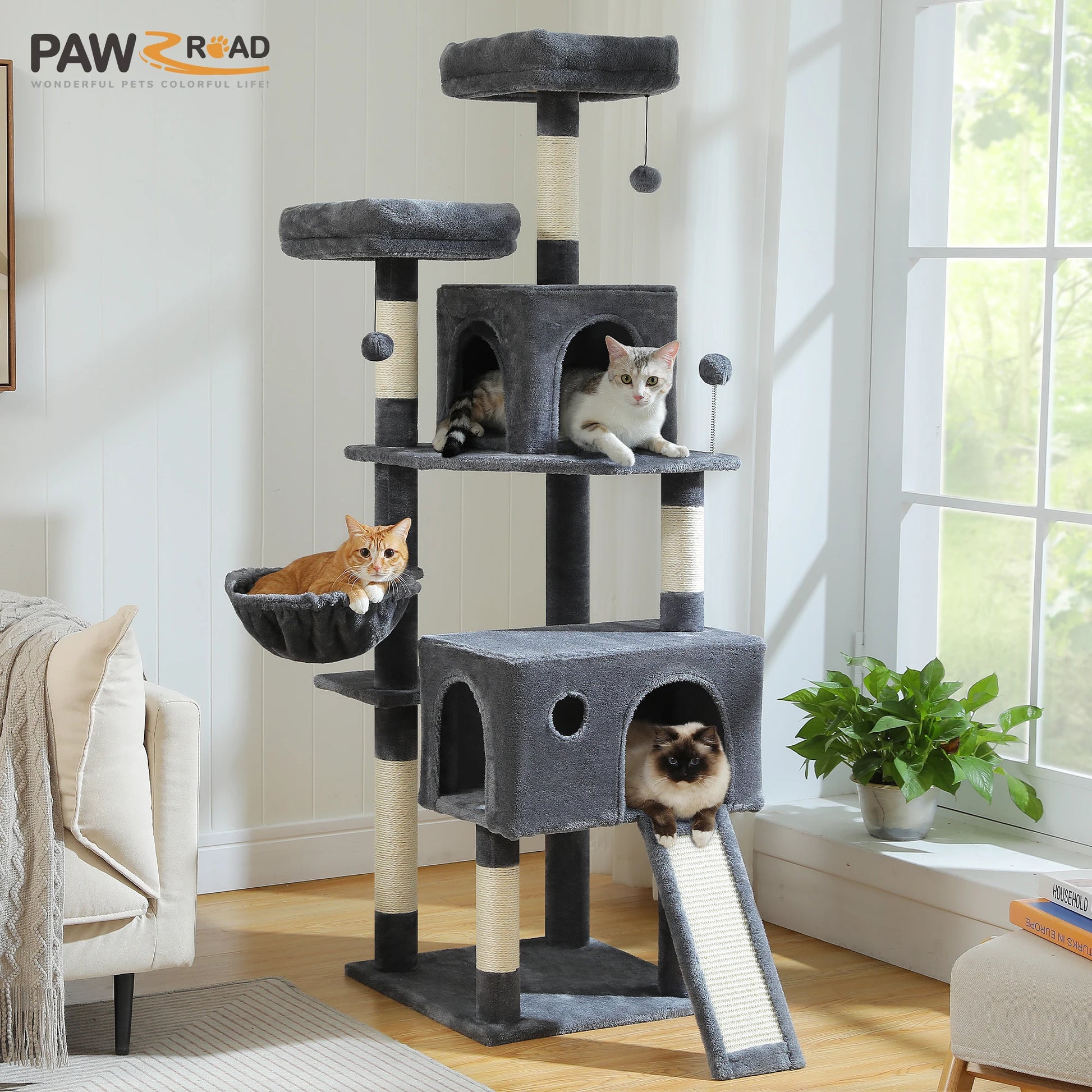
For multi-cat households, a large multi-level cat tree is one of the most effective environmental interventions available. Our large cat tree collection covering 100cm to 200cm includes structures specifically suited to households where separate vertical zones are the priority - with multiple platforms, condos at different heights, and hammocks that give each cat a distinct and defensible resting spot.
The 180cm luxury multi-level cat tree with condos, hammock, and scratching posts is designed with this specifically in mind. It accommodates up to four to six small and medium cats simultaneously, with two condos, two perches, a hammock, and multiple scratching posts distributed across the structure - giving each cat meaningful separation and its own territory within a single piece of furniture.
Signs Your Cat Needs More Vertical Territory
Cats do not generally signal unmet needs through obvious communication. But there are behavioural patterns that often indicate a cat is working with insufficient vertical space.
Persistent counter-surfing and furniture climbing is one of the most common. When a cat repeatedly climbs onto kitchen counters, shelving units, or the top of the refrigerator, they are not usually doing it for mischief. They are seeking the elevated vantage point they need, using whatever is available. Providing a purpose-built high perch in a location the cat frequents often reduces or eliminates this behaviour.
Inter-cat tension and conflict in multi-cat homes, particularly where cats seem to block each other's movement through the house, guard doorways, or chase each other off furniture, frequently has a territorial root. Expanding the available vertical territory is one of the first interventions worth trying before assuming the cats are simply incompatible.
Anxious or withdrawn behaviour in a single cat, including hiding frequently at ground level, avoiding certain rooms, or startling easily, can sometimes reflect an environment that does not provide enough elevated retreat space for the cat to feel secure.
Excessive or redirected scratching on furniture can also be a territorial signal. Scratching is one of the ways cats mark territory visually and through scent glands in the paws. When a cat scratches furniture rather than a post, it is worth considering whether the scratching location is itself a territorial marker - possibly a door frame, a corner, or a piece of high-traffic furniture in the middle of the home.
Our post on how cat trees support feline mental health and behavioural wellbeing covers the broader behavioural picture, including how vertical space intersects with stress, anxiety, and enrichment for indoor cats.
Practical Ways to Increase Vertical Territory at Home
Cat trees and towers are the most practical way to add meaningful vertical territory, particularly for renters or in homes where wall-mounted systems are not an option. A well-placed multi-level tower can provide three or four distinct territorial zones in a relatively small floor footprint.
Placement matters considerably. A cat tree positioned near a window gives the cat both vertical territory and visual access to the outdoor environment - birds, passing movement, weather - which adds significant enrichment beyond the territorial function alone. A tower placed in a corner gains added stability and a backed, secure feeling that cats tend to prefer to a structure surrounded on all sides by open space.
For households where floor space is genuinely limited but vertical territory is still important, wall-mounted climbing sets offer an alternative approach. These systems attach to the wall and provide climbing routes, perches, and hammocks that use wall space rather than floor area. Our wall-mounted cat climbing set collection includes several configurations suited to apartments and modern homes where permanent wall fixings are feasible.
For those who want a single structure that provides maximum vertical range without wall mounting, the adjustable 229-275cm cactus floor-to-ceiling cat tower with scratching post and hammock uses ceiling tension to create a highly stable, full-height climbing structure that spans the full vertical range of the room. This type of structure gives cats the maximum available height in a given space and is particularly well-suited to active climbers or households where multiple cats need genuinely separate vertical territory.
The 115-175cm large adjustable multi-level indoor cat tree offers a more adjustable mid-range option, with height flexibility, multiple perch levels, scratching boards, and enclosed cave spots that suit cats who want both elevation and shelter. It is a practical all-rounder for single-cat homes or two-cat households where territorial separation across a few distinct levels is the goal.
For further reading on how vertical enrichment fits into a broader approach to indoor cat wellbeing, our post on why indoor cats benefit from vertical climbing and physical activity is a useful companion piece.
Thinking About Territory Holistically
Vertical space is one component of a cat's territorial environment, not the whole picture. Food stations, litter trays, scratching surfaces, and rest spots also constitute territorial resources - and in multi-cat homes, each of these should be available in sufficient numbers and positions to reduce competition.
But vertical space is often the most overlooked element, partly because it is less intuitive to humans who organise their own lives primarily in horizontal terms. Once you understand that your cat's territory extends upward as meaningfully as it extends outward across the floor, the relevance of a well-placed, thoughtfully chosen cat tree changes from a nice-to-have to a genuine quality-of-life consideration.
If you are trying to work out what vertical space setup would suit your cat's breed, temperament, and living environment, Cat Tree Haven is happy to help you think through the options.
Reach out to our team here and we will point you toward something that works for your cat and your home.
Frequently Asked Questions
Why do cats want to be up high?
Cats are instinctively drawn to elevated positions because height provides a secure vantage point for monitoring their environment and asserting territorial status. This behaviour is rooted in their evolutionary history as both predators and prey, and is present in virtually all domestic cats regardless of breed.
Does vertical space reduce conflict between cats?
Research indicates that access to vertical space is associated with reduced agonistic (conflict) behaviour in multi-cat environments. By allowing cats to occupy distinct height levels simultaneously, vertical structures effectively expand the available territory without increasing floor space, which reduces direct competition.
How much vertical space does a cat need?
There is no single prescribed amount, as needs vary by individual cat, activity level, and household size. As a general guide, a cat should have access to at least one elevated perch at a height where it can survey the primary living area. Multi-cat households benefit from structures with distinct levels at genuinely different heights so each cat can claim a separate zone.
Can vertical space help with cat anxiety?
Elevated retreat points can contribute to a cat's sense of security and control in its environment, which may reduce baseline anxiety. Cats that feel they have safe, elevated options available often show calmer, more confident behaviour than those restricted to ground level. However, if a cat is showing significant anxiety, a consultation with a vet or feline behaviour specialist is advisable.
Do indoor cats really need a cat tree?
Indoor cats have no outdoor territory to express their climbing and territorial instincts, making vertical structures indoors considerably more important than for cats with outdoor access. A cat tree or tower is one of the most direct ways to provide indoor cats with the height-based territory their instincts require.
What is the best placement for a cat tree to maximise territorial benefit?
Near a window is widely recommended, as it combines vertical territory with visual access to the outdoor environment. Corner placement adds stability and gives the cat a backed, secure feeling. Avoid positioning in high-traffic hallways or spaces where the cat will feel exposed on all sides while resting.
Does the height of the cat tree matter?
Yes, for cats that are active climbers or for multi-cat households. A taller structure provides more distinct vertical zones that separate cats can claim independently. For a single cat of moderate activity level, a mid-height tree of 100-150cm is often adequate. For multi-cat homes or larger, more active breeds, taller structures of 150cm and above provide meaningfully more territorial resource.