
The idea of building your own cat tree has a certain appeal. You control the size, the layout, the materials, and the finished look. You can customise it for your specific cat, your specific room, and presumably save some money in the process. For cat owners who enjoy woodworking or crafting, it sounds like an ideal weekend project.
And for some people, it is. A well-built DIY cat tree made by someone with solid carpentry skills and careful material choices can be a genuinely good piece of cat furniture. But the reality of most DIY cat tree projects is more complicated than the Pinterest results suggest, and the gap between a satisfying build and a wobbly structure that never quite gets used can be significant.
At Cat Tree Haven, we believe in being honest about what goes into a quality cat tree and what the real comparison looks like when you put DIY against store-bought side by side. Here is that comparison, laid out properly.
What a DIY Cat Tree Actually Involves
The basic construction of a cat tree - a base board, a central post, some platforms at different heights, a sisal-wrapped section for scratching - is not particularly complicated in concept. In practice, execution is where the challenges emerge.
Materials sourcing is more involved than it appears. A DIY cat tree typically requires plywood or timber offcuts for platforms and the base, a post or series of posts (often PVC pipe or treated timber), sisal rope for scratching surfaces, carpet remnants or plush fabric for platform coverings, screws, wood glue, non-toxic adhesives for the fabric, and potentially a drill, saw, and sander. In Australia, sisal rope alone can be expensive - quality sisal from a hardware store like Bunnings costs per metre, and a single well-wrapped post requires considerably more rope than most first-time builders budget for. Australian builders working from scratch typically report total material costs ranging from around $80 to over $150 for a basic structure, depending on the number of levels and the quality of materials chosen.
The structural engineering requires genuine thought. A cat tree is not just furniture that looks like a tree - it is a structure that will repeatedly support the dynamic load of a cat jumping on and off it from various heights. The force a cat generates when landing on a platform from a height is significantly greater than the cat's resting body weight. A structure that feels solid when you push it with your hand may behave very differently when a five-kilogram cat lands on the top perch from a metre below. This is not theoretical - an unstable DIY tree is one of the most common reasons owners report that their cat stopped using it. Cats that experience a wobble or a near-tip tend to avoid the structure afterwards, regardless of how much effort went into building it.
Material safety requires careful attention. Cats chew, lick, and scratch the surfaces they interact with. Treated timber, certain adhesives, chemical wood finishes, and synthetic fabrics can contain compounds that are not safe for a cat that is scratching and mouthing the surface regularly. Untreated natural wood, pet-safe adhesives, and natural sisal rope are the materials recommended by experienced DIY builders. Sourcing genuinely non-toxic alternatives takes more effort than simply picking up the cheapest option at the hardware store.
The Real Cost Comparison
One of the main motivations for a DIY build is cost saving, and it is worth looking at this honestly.
A basic DIY cat tree built from plywood, timber, sisal rope, and carpet remnants typically costs somewhere between $80 and $150 in materials in Australia, before time. That places it broadly in the same range as a budget-to-mid-range store-bought tree. For a more complex DIY build with multiple platforms, an enclosed condo, and a hammock, material costs rise considerably.
Time has a value too. A first-time DIY cat tree build typically takes a full day or weekend, including measuring, cutting, sanding, assembling, and wrapping. An experienced builder might complete a simpler version faster, but even then, the time investment is not trivial. When you factor in the hours involved alongside the material costs, the cost-per-outcome comparison with a quality store-bought tree is often much closer than it initially appears.
Store-bought cat trees from quality Australian retailers are sourced, manufactured, quality-checked, and often pre-tested for load capacity. The mid-range options at Cat Tree Haven - priced between $100 and $250 - include sisal posts, plush platforms, enclosed condos, and robust base construction that would cost meaningfully more to replicate from scratch, even with basic carpentry skills.
Our guide on whether expensive cat trees represent good value covers how pricing works in the cat furniture market and why mid-range options from direct-to-consumer retailers often represent significantly better value than both budget options and heavily marked-up premium brands.
Where DIY Has a Genuine Advantage
Being fair about this comparison means acknowledging where DIY does come out ahead for certain owners.
Customisation for unusual spaces. Store-bought cat trees come in standard configurations. If your home has a very specific nook, an unusual ceiling height, or a particular corner that would benefit from a purpose-built structure, a DIY build can be designed around those exact dimensions in a way that no off-the-shelf product can replicate.
Satisfaction and engagement. For owners who genuinely enjoy woodworking and crafting, the process of building something for their cat has value beyond the finished product. This is a legitimate reason to build rather than buy, as long as the structural and safety considerations are taken seriously.
Specific material preferences. If an owner has a strong preference for a particular timber species, a specific finish, or a very particular aesthetic that does not exist in any available product, building from scratch is the only way to get exactly what they want.
Repairability. A DIY structure where the builder knows every component can be disassembled and repaired more easily than a commercial product where components may not be individually replaceable.
Where Store-Bought Has a Clear Advantage
For most Australian cat owners who are not experienced woodworkers, the store-bought path has some concrete advantages that are worth being direct about.
Tested structural integrity. Commercial cat trees from reputable retailers are designed with load distribution in mind and tested to consistent standards before sale. The base dimensions, platform spacing, and post construction are not guesswork - they reflect the manufacturer's engineering of a structure that will hold a cat's weight under dynamic conditions. Our post on what keeps cat trees stable and safe covers what structural integrity looks like in practice.
Material safety assurance. A quality cat tree from a reputable retailer is built with materials chosen for pet safety. Non-toxic plush fabric, natural sisal, pet-safe adhesives, and formaldehyde-free boards are standard for well-made commercial products. An owner building their own needs to research and verify each material themselves, which adds complexity and requires more sourcing effort.
Consistent quality at scale. Manufacturers producing cat trees at volume can source quality materials at lower cost than an individual home builder purchasing from a hardware store in small quantities. This is one of the reasons that a quality mid-range store-bought tree is often structurally competitive with or superior to a DIY build at a similar total cost.
Time investment. For cat owners without carpentry experience or tools, a DIY build that is structurally sound is a significant undertaking. A store-bought tree arrives flat-packed and requires assembly that typically takes one to two hours rather than a full weekend.
What to Look for in Either Case
Whether you build or buy, the same fundamental criteria apply to a cat tree that will actually be used and stay safe over time.
Base width and weight. The base must extend well beyond the central post to prevent tipping under lateral force. A wide, heavy base is the single most important stability feature in any cat tree.
Post rigidity. The central post or posts should not flex when you push against them at mid-height. Hollow posts, thin cardboard tubes, and narrow PVC without reinforcement all compromise stability.
Platform security. Each platform needs to be firmly fixed to its support, with no play or wobble. A platform that shifts when a cat lands on it will be avoided.
Non-toxic materials throughout. Sisal, plush fabric, adhesives, wood finishes - all surfaces and materials need to be safe for a cat that will chew, scratch, and rest on them daily.
Appropriate scale for your cat. Platform size, the gap between levels, and overall height should suit your cat's size and physical condition. Our post on how to match a cat tree to your cat's size and life stage covers this in more depth.
Specific Products Worth Considering
If you are leaning toward store-bought and want to understand what quality mid-range options look like, a few products from Cat Tree Haven illustrate the range well.
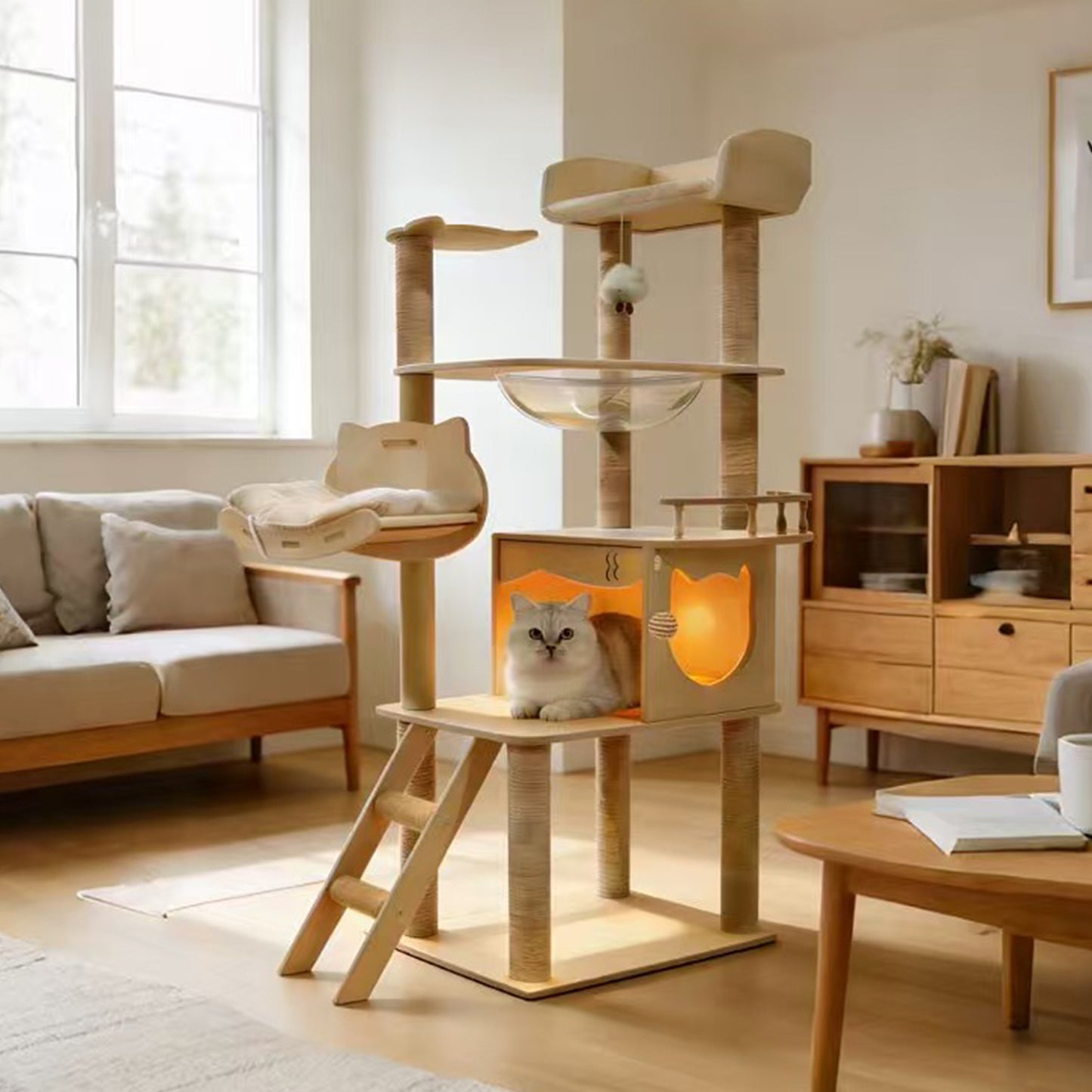
The 110cm modern wooden cat tree with scratching post and stylish climbing tower is a compact, well-constructed option with a natural wood finish that suits contemporary Australian interiors. It combines a sisal post, multiple platforms, and solid construction in a footprint that suits smaller homes and apartments - the kind of structure that would be time-consuming and technically demanding to replicate from scratch.
For something with more vertical range and multiple activity zones, the 152cm multi-level cat tree with condo includes an enclosed condo, multiple perch levels, and sisal posts within a structure built for stability under active use. Replicating this level of design detail in a DIY build would require significant time and skill.
Our broader large cat tree collection from 100cm to 200cm covers the range of multi-level options for active adult cats and multi-cat households, with the full product specifications listed so you can assess base dimensions, materials, and construction detail before purchasing.

The Honest Verdict
DIY cat trees can be excellent - but only when built by someone with genuine carpentry skills, careful attention to material safety, and a thorough understanding of the structural requirements of a load-bearing climbing structure. For that person, a custom build is a rewarding and viable option.
For most cat owners, a quality mid-range store-bought tree from a specialist Australian retailer provides better structural assurance, comparable or better material quality, and a significantly lower time investment - often at a total cost that is not dramatically higher than a properly sourced DIY build.
The worst outcome in either case is an unstable structure. A cat that has a negative experience with a wobbly tree tends to avoid it permanently, which means the investment - of money or time - has been wasted. Starting with a structurally sound option, whether built or bought, is the most important criterion.
If you have questions about which store-bought option suits your specific cat, space, and budget, Cat Tree Haven is happy to help.
Get in touch with our team here and we will point you toward the right fit.
Frequently Asked Questions
Is building a DIY cat tree cheaper than buying one?
Not always. In Australia, materials for a basic DIY build - timber, sisal rope, fabric, hardware - typically cost between $80 and $150, placing the total in a similar range to mid-quality store-bought options. When time is factored in, the cost-per-outcome comparison is often much closer than expected. A quality store-bought tree frequently offers better structural integrity for a comparable total investment.
What materials are safe for a DIY cat tree?
Untreated natural timber (pine and plywood are common choices), natural sisal rope, pet-safe non-toxic adhesives, and natural or plush fabric without synthetic chemical treatments are the recommended materials. Treated timber, certain wood finishes, standard craft glues, and some synthetic fabrics may contain compounds that are not safe for a cat that chews and scratches the surface.
What is the biggest risk with a DIY cat tree?
Structural instability is the most significant risk. A tree that wobbles or tips under the dynamic load of a jumping cat can cause injury, and a cat that experiences instability will often stop using the structure permanently. Ensuring an adequately wide, heavy base and rigidly secured platforms requires genuine understanding of load-bearing principles, not just a basic understanding of woodworking.
How do I know if a store-bought cat tree is good quality?
Check the base dimensions relative to the overall height, confirm the post construction is solid rather than hollow or thin, look for natural sisal on the scratching surfaces, and verify that the platform fixings are secure rather than friction-fit or lightly glued. Reading product specifications carefully, rather than relying on marketing descriptions, gives a more accurate picture of build quality.
Can a DIY cat tree be as sturdy as a store-bought one?
Yes, if built by someone with solid carpentry skills using appropriate materials and load-bearing principles. A well-engineered DIY tree using solid timber, a wide plywood base, and properly secured platforms can match or exceed the stability of a commercial product. The challenge is that most DIY builds are by people without this specific knowledge base, which is where instability commonly occurs.
What should I prioritise if I decide to build a DIY cat tree?
Base width and weight are the most critical factors. The base should extend well beyond the central post in every direction. Posts should be rigid when tested with lateral force at mid-height. Every platform join needs to be mechanically secure - screwed and glued, not relying on either alone. All materials must be non-toxic for a cat that will scratch and mouth the surfaces.
How long does it take to build a DIY cat tree?
A basic single-post tree with one or two platforms typically takes half a day for someone with basic carpentry tools and skills. A multi-level tree with enclosed condos, wrapped sisal posts, and padded platforms can take a full weekend, including drying time for adhesives. First-time builders often find the project takes longer than anticipated, particularly the sisal wrapping, which requires patience and consistent tension to do properly.