
Key Takeaways
- Cats have instinctive needs for vertical space, scratching surfaces, and secure resting spots that are largely unmet in standard indoor environments
- Behavioural science consistently links environmental enrichment - including climbing structures - with reduced stress and improved welfare in indoor cats
- A cat tree is not a luxury item; for an indoor-only cat, it addresses several core behavioural needs simultaneously in a single structured piece of furniture
- The absence of climbing and scratching outlets is connected to a range of stress-related behaviours including furniture destruction, hiding, and increased anxiety
- Outdoor cats meet these needs naturally through trees, fences, and terrain; indoor cats need deliberate provision of the same resources
- Cat Tree Haven stocks a range of cat trees designed to meet the genuine behavioural needs of indoor cats, with free shipping across Australia
"Do cats need a cat tree?" is the kind of question that sounds simple but opens into something considerably more interesting the moment you look at it seriously. The short answer is no - cats don't die without a cat tree, and plenty of indoor cats live without one. But that framing misses the point in a way that matters for anyone who cares about their cat's actual quality of life.
A better question is this: what do indoor cats need to be behaviourally healthy, and does a cat tree provide those things? When you approach it from that angle, the answer becomes much clearer. This article works through what behavioural science actually says about the environmental needs of domestic cats, why indoor environments so often fall short, and where a cat tree fits into that picture.
The Starting Point: What Do Indoor Cats Actually Need?
To assess whether a cat tree is genuinely useful, it helps to start from first principles - the core behavioural needs of cats that have been identified through research in feline behaviour and welfare science.
Cats are obligate carnivores with a solitary hunting background. Unlike dogs, who have been domesticated and selectively bred over thousands of years to coexist with humans in a fundamentally different way, cats retain a much closer relationship to their wild behavioural template. The domestic cat - even one that has lived in a flat for its entire life - operates with a behavioural system built for a very different environment than the average Australian home provides.
Researchers in feline welfare broadly identify five categories of need that are relevant to the indoor cat environment. These are adapted from the Five Domains model and similar frameworks used in animal welfare science:
- Access to vertical space and elevated resting positions
- Appropriate surfaces for claw maintenance (scratching)
- Opportunities for predatory play and physical exercise
- Secure hiding and retreat spaces
- A sense of environmental control and predictability
A well-designed cat tree directly addresses at least four of these five needs within a single piece of furniture. That's worth taking seriously.
Vertical Space: Not a Preference, a Need
The drive to seek height in cats is not a preference in the way that a human might prefer a particular chair. It's an instinctive behaviour rooted in survival mechanisms that have been selected for over a very long evolutionary period. Cats who could reach and utilise elevated positions had better visibility of their environment, reduced vulnerability to ground-level threats, and more effective hunting vantage points. These advantages translated directly into survival and reproductive outcomes.
The result is a domestic animal whose nervous system is still calibrated for a world in which height access is important for safety and function. In an indoor environment with no vertical structure designed to support this, cats improvise - climbing bookshelves, refrigerators, wardrobes, and anything else that provides elevation. This isn't misbehaviour; it's a completely rational response to an environment that isn't meeting a genuine need.
Providing structured vertical access through a cat tree gives cats something that works with their instincts rather than against them. It's one of the most straightforward environmental modifications an owner can make for an indoor cat. Our post on the behavioural reasons cats seek out high places and what this means for indoor cats explores the evolutionary background of this in more detail.
Scratching: Widely Misunderstood
Scratching is one of the most commonly misunderstood cat behaviours, and it's worth addressing directly because it's one of the primary reasons cat trees get dismissed as a solution to furniture damage rather than understood as a welfare provision.
Cats scratch for multiple interconnected reasons. They scratch to maintain their claws - removing the outer sheath of dead material to keep the claw sharp and healthy. They scratch to stretch the muscles and tendons of their legs, shoulders, and back. And they scratch to deposit scent from glands in their paw pads, marking territory in a way that communicates their presence to themselves and to other cats.
These are not bad habits. They are normal, healthy, essential behaviours. A cat that does not scratch is a cat that is suppressing a functional biological drive, which is not in any sense an improvement on the cat scratching your couch. What changes when you provide an appropriate scratching surface is where the scratching happens - not whether it happens.
This reframing matters because it changes what you're looking for in a cat tree. The scratching posts on a cat tree are not a diversion or a toy. They're a functional necessity. For this reason, the material of the scratching post matters considerably. Natural sisal - wound tightly around a post of adequate diameter - is generally considered the most appropriate surface for cat scratching. It satisfies the sensory and physical experience of scratching, is durable under repeated use, and doesn't shed in ways that could pose an ingestion risk.
Carpet-covered posts are common in cheaper cat trees but are less effective because carpet satisfies scratching behaviour less completely and can also confuse the boundary between acceptable and unacceptable scratching surfaces in the home.
Retreat and Security: The Overlooked Function
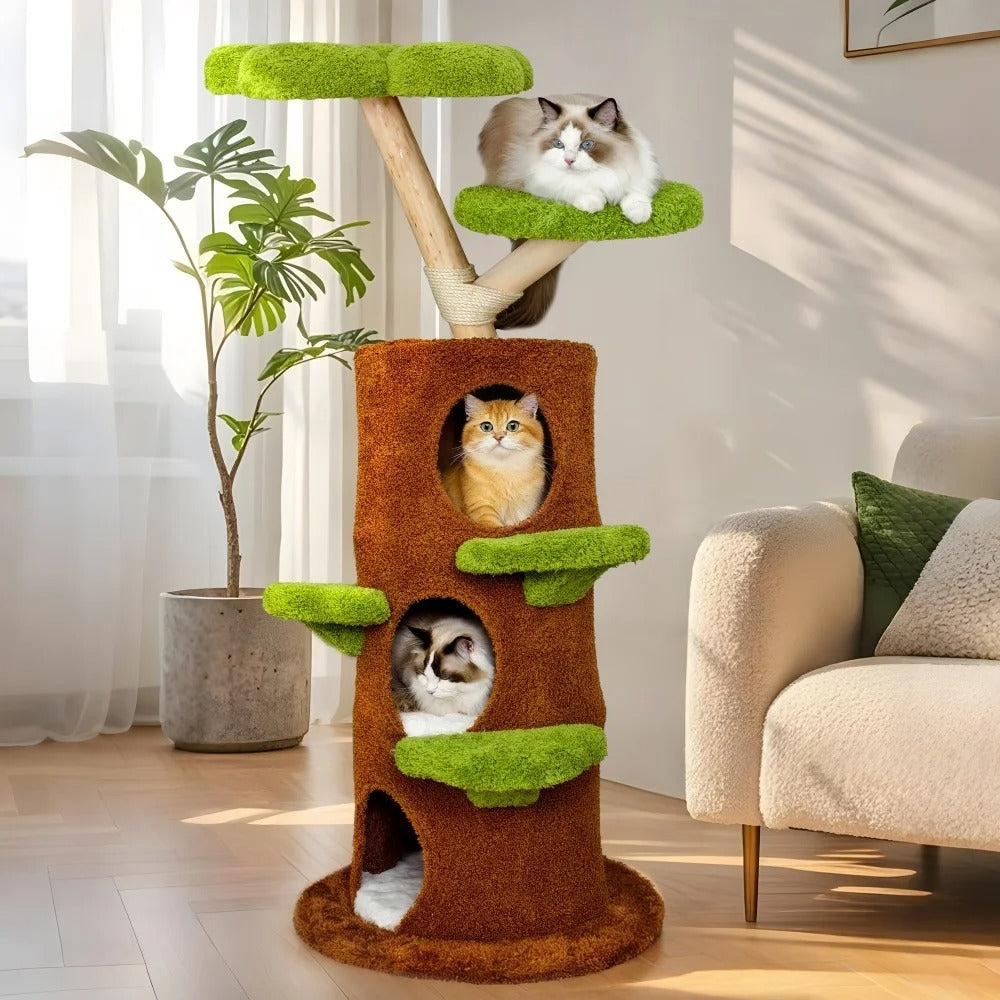
The third core function of a cat tree that's often underemphasised is the provision of a secure retreat space. Enclosed condos and covered perches on a cat tree give cats somewhere to rest that provides both elevation and enclosure - a combination that addresses two separate aspects of the feline need for security during rest.
Cats sleep for extended periods and are vulnerable during sleep. The neurological drive to find a secure resting position - ideally elevated and partially enclosed - is as persistent as the drive to seek height when active. A cat that has no secure retreat in their environment will often show signs of chronic low-level stress: sleeping lightly, waking easily, remaining vigilant in a way that prevents genuine rest.
For anxious cats, or for cats in homes with multiple animals or young children, a high enclosed condo on a cat tree can function as a genuine safe zone - a place where the cat is above the activity of the household, partially hidden, and able to rest without feeling exposed. This is not a minor comfort. It's a meaningful contribution to the cat's psychological wellbeing.
The Indoor Environment and Behavioural Problems
Behavioural problems in indoor cats - excessive scratching of furniture, increased vocalisation, inter-cat aggression, hiding, and compulsive behaviours - are frequently connected to environmental insufficiency. A cat whose environment doesn't meet their behavioural needs will redirect those needs somewhere. The redirection is usually visible as a problem behaviour, but the problem is typically the environment rather than the cat.
Environmental enrichment - including vertical space, scratching surfaces, and retreating options - is consistently recommended in veterinary behavioural guidelines as a first-line response to many common indoor cat behavioural concerns. This isn't a niche or alternative approach; it's mainstream applied animal behaviour science.
A cat tree is a practical, consolidated way to address several dimensions of environmental insufficiency simultaneously. It's not the only approach, and it won't resolve behavioural problems that have other causes, but for a cat whose environment is lacking in vertical territory, scratching outlets, and secure resting spots, it addresses all three in a single purchase.
For a deeper look at how climbing and vertical access specifically relates to cat stress and anxiety management, our post on how cat trees can help reduce stress and promote healthier play patterns covers the welfare dimension in more detail.
What About Cats Who Go Outside?
Outdoor cats and cats with regular outdoor access meet most of these needs naturally. Trees, fences, walls, and garden structures provide vertical territory. Natural surfaces and tree bark provide scratching opportunities. The outdoor environment offers the kind of environmental complexity that stimulates healthy behaviour without any specific provision from the owner.
Indoor-only cats have none of that. They're living in an environment that was designed for humans, not for a small territorial predator with a nervous system built for hunting and vertical space use. The absence of outdoor access is increasingly common in Australian urban environments, partly for safety reasons - roads, predators, and disease risk all make indoor-only living a reasonable choice for many owners. But the behavioural trade-off of keeping a cat exclusively indoors needs to be actively compensated for through environmental provision.
A cat tree is part of that compensation. It's not the only part - interactive play, feeding enrichment, and social interaction all matter too - but it's one of the more significant environmental modifications an owner can make for an indoor-only cat.
Choosing a Cat Tree That Actually Meets These Needs
Not all cat trees are equal in terms of how well they address the behavioural needs described above. A compact carpet-covered structure with a single thin scratching post and one small platform addresses these needs less completely than a well-designed multi-level tree with solid sisal posts, an enclosed condo, and multiple platforms at different heights.
For a cat in a smaller home or apartment, the 110cm modern wooden cat tree with scratching post and stylish climbing tower provides genuine height and a quality scratching surface in a form that works in a contemporary interior without dominating the space.
For cats who need more vertical territory - particularly active cats or those in multi-cat households where vertical space functions as social territory - the 153cm tall cat tower with large cat condo, cosy perch bed, scratching posts, and cat toys addresses height, enclosed retreat, scratching, and play stimulation within a single structure.
For larger homes or for households with multiple cats, the large multi-level cat tree range at 172cm with condo and scratching posts provides more substantial vertical territory with the structural mass to handle regular use by more than one cat.
The Cat Tree Haven large cat tree collection (100-200cm) is a useful starting point for cat owners looking for trees that address genuine behavioural needs rather than simply providing a surface to sit on. For cats in smaller spaces, the small cat tree collection (under 100cm) offers options that work in more compact environments without compromising on the core features that matter.

The Honest Summary
Do cats need a cat tree? Not in the way they need food or water. But indoor cats do need vertical access, scratching surfaces, and secure resting spots - and a cat tree is one of the most efficient and practical ways to provide all three. For an outdoor cat with access to a garden and natural structures, a cat tree may be redundant. For an indoor-only cat in an Australian home or apartment, the case for providing one is grounded in genuine welfare science rather than marketing.
The question worth asking isn't whether your cat needs a cat tree specifically. It's whether your cat's environment is currently meeting their behavioural needs for height, scratching, and secure retreat - and if it isn't, what the most practical way to address that is. For most indoor cat owners, a well-chosen cat tree is a straightforward answer to that question.
Have Questions About What Your Cat Needs?
If you'd like help choosing a cat tree that suits your cat's specific needs and your home environment, the team at Cat Tree Haven is happy to assist. We can help you think through size, features, and placement to find something that's actually going to be used.
Get in touch with the Cat Tree Haven team and we'll point you in the right direction.
Frequently Asked Questions
Do indoor cats really need a cat tree? Indoor cats have instinctive needs for vertical space, scratching surfaces, and secure resting spots that a standard home environment doesn't automatically provide. A cat tree addresses all three simultaneously. While cats won't suffer acute harm without one, the absence of these environmental resources is associated with stress-related behaviours and reduced welfare in indoor cats. For indoor-only cats, a cat tree is a meaningful welfare provision rather than a luxury.
What does a cat tree actually do for a cat?
A well-designed cat tree provides vertical territory for climbing and resting at height, sisal scratching surfaces for claw maintenance and territorial marking, enclosed spaces for secure retreat during rest, and a base for play and physical activity. It addresses several distinct behavioural needs within a single piece of furniture, making it one of the more efficient environmental enrichment options for indoor cats.
Can a cat be happy without a cat tree?
Cats can function and appear content without a cat tree, particularly if their environment provides other forms of enrichment and they have outdoor access to natural climbing and scratching resources. For indoor-only cats without these alternatives, the absence of vertical territory and appropriate scratching surfaces is more likely to manifest as behavioural problems or low-level stress over time. Happiness in cats is partly a function of whether their environment meets their instinctive needs.
Do cats use cat trees less as they get older?
Older cats typically reduce the height and frequency of their climbing as joint mobility decreases with age. However, the underlying preference for elevated resting positions often remains. Senior cats tend to benefit from cat trees with lower platforms, wide steps, and less demanding jump distances between levels - allowing them to continue accessing height at a scale that suits their current physical capability.
Is a scratching post just as good as a cat tree?
A standalone scratching post addresses one specific need - claw maintenance and territorial marking through scratching. A cat tree addresses that need plus vertical territory access and, in most designs, enclosed resting spaces. If the only gap in your cat's environment is a scratching outlet and they have access to height through other means, a standalone post may be sufficient. For most indoor cats, a cat tree is more comprehensive because it addresses multiple behavioural needs at once.
How do I know if my cat needs more environmental enrichment?
Common indicators that an indoor cat's environment is not meeting their behavioural needs include excessive or misdirected scratching of furniture or carpets, increased hiding, heightened reactivity to noise and movement, increased vocalisation, overgrooming, or conflict with other pets in the household. These behaviours can have other causes, but environmental insufficiency - particularly a lack of vertical territory and scratching options - is a frequent contributing factor worth addressing.
Do vets recommend cat trees?
Veterinary behaviourists and feline welfare organisations generally recommend environmental enrichment for indoor cats, which includes access to vertical space and appropriate scratching surfaces. Cat trees are a commonly recommended component of indoor cat enrichment in veterinary behaviour guidelines. If your cat is showing stress-related behaviours, discussing environmental enrichment options with your vet is a sensible first step.