
Key Takeaways
- Anxiety in indoor cats is frequently rooted in environmental deficiency rather than personality or temperament alone
- Vertical access, secure retreat spaces, and scratching surfaces - all provided by a cat tree - directly address the core conditions that contribute to feline anxiety
- An elevated perch gives anxious cats a sense of environmental control, which is one of the key factors in reducing chronic low-level stress
- Enclosed condos on cat trees provide a retreat that meets the instinctive feline need for safe, partially hidden resting during vulnerable periods
- Scratching is a self-soothing and territorial behaviour; providing an appropriate outlet for it reduces the anxiety associated with unmet territorial needs
- Cat trees are not a treatment for clinical anxiety - persistent or severe anxiety in cats should be assessed by a veterinarian
- Cat Tree Haven stocks a range of cat trees designed to support indoor cat wellbeing, with free shipping across Australia
If you live with an anxious cat, you probably already know the signs. The hiding that extends beyond a few hours. The vigilance during rest, waking at minor sounds that most cats sleep through. The excessive grooming, the increased reactivity, the reluctance to settle in the main areas of the home. These behaviours can be distressing to witness, and finding a practical way to address them is something many cat owners actively seek out.
What's less commonly understood is that anxiety in indoor cats is often - not always, but often - partly a function of the environment rather than purely an inherent trait of the individual cat. A cat whose environment doesn't meet their instinctive needs for vertical territory, secure retreat, and scratching outlets is a cat who is chronically missing resources that their nervous system expects to have. That absence creates a kind of low-level background stress that accumulates over time and manifests in the behaviours described above.
This is where cat trees become relevant - not as a magic solution, but as a targeted environmental modification that addresses several of the specific conditions that contribute to anxiety in indoor cats. This article explains the mechanism behind that connection clearly and without overstatement.
Please note: this article is educational in nature. If your cat is showing signs of significant anxiety or stress-related behaviour, consulting a veterinarian or veterinary behaviourist is always the appropriate first step. Cat trees are an environmental enrichment measure and not a substitute for professional assessment and advice.
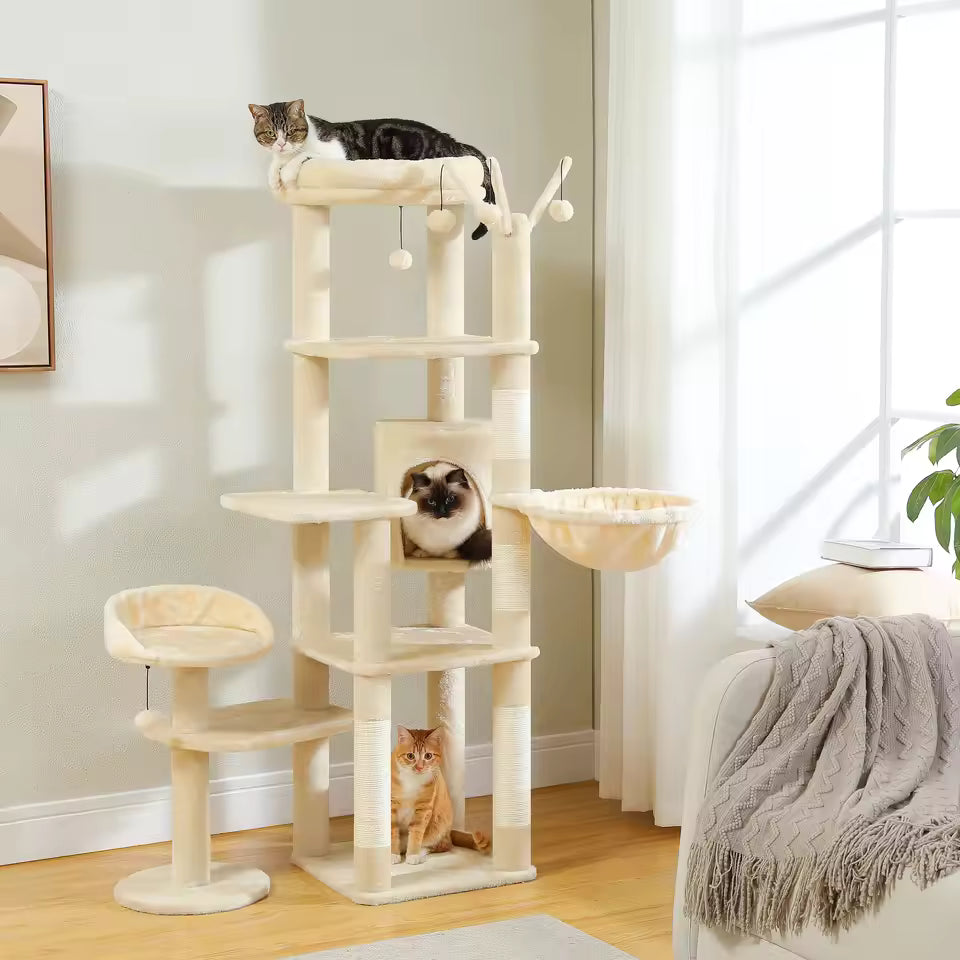
Understanding Feline Anxiety in an Indoor Context
Cats evolved as both predators and prey animals. This dual role shaped a nervous system that is constantly assessing the environment for risk, tracking available resources, and maintaining readiness to respond to threats. In the wild, cats manage this through a combination of environmental navigation - using height, cover, and territory - and behavioural outlets like hunting, scratching, and exploratory movement.
In an indoor environment, the same nervous system is running the same threat-assessment and resource-monitoring processes, but with far fewer of the environmental variables that the system was built to work with. There's no height to retreat to. There may be no adequate scratching surface. There are no defined territory boundaries that the cat has been able to mark and monitor. The environment feels fundamentally unpredictable and insufficiently controlled from the cat's perspective, even if it appears perfectly calm to the humans in the household.
This is the core mechanism through which environmental deficiency contributes to feline anxiety. It's not that the indoor environment is dangerous - it's that it lacks the structural features that a cat's nervous system uses to feel secure. A cat tree addresses several of those missing features simultaneously.
How Vertical Access Reduces Anxiety
Height is one of the most significant environmental resources for cats managing stress. An elevated position gives a cat an unobstructed view of the surrounding space, which directly supports the threat-assessment function of their nervous system. A cat who can see the entire room from above - who can monitor the door, track movement, and observe the environment without being in the middle of it - is a cat whose nervous system is receiving the information it needs to register the space as safe.
This is meaningfully different from a cat confined to ground level, who has to be in the environment to monitor it and therefore has less predictive control over what approaches them. The ground-level cat is constantly in the position of reacting rather than observing - which is a more stressful operating mode.
Research in feline welfare and environmental enrichment consistently supports access to elevated resting positions as a significant factor in reducing stress indicators in indoor cats. The elevation itself, and the sense of environmental control it provides, is the operative variable. A cat on a high perch is not just physically elevated - their nervous system registers a qualitatively different level of security than it does at floor level.
Our post on how cat towers help reduce boredom and anxiety in indoor cats explores the broader enrichment dimension of this, including the relationship between boredom and anxiety that is often underappreciated in indoor cat welfare.
The Role of Enclosed Retreat Spaces
The second major anxiety-relevant feature of a cat tree is the enclosed condo or cave-style perch. Anxiety in cats is strongly connected to the availability - or absence - of secure retreat spaces. A cat who has nowhere to retreat that feels safe and enclosed will often show heightened anxiety because there is no behavioural option available to them when the environment feels overwhelming.
Enclosed resting spaces address this need by providing a location that combines height with partial concealment. The cat can see out but is not fully visible from the outside, is above the level of ground-based activity, and is in a physically bounded space rather than an open platform where they might be approached from any direction.
This combination of height and enclosure is particularly relevant for cats who are anxious because of other animals in the household, because of noise or activity levels, or because they are generally more sensitive temperamentally. The enclosed condo becomes a safe zone where the cat can regulate their own stress response by withdrawing when the environment becomes too stimulating and returning when they feel ready.
For cats who are new to a household, in a multi-animal home, or who have a history of stress or anxiety, an enclosed condo on a cat tree is often the feature that gets the most consistent use. It's worth prioritising when choosing a cat tree for an anxious cat.
Scratching as a Stress-Management Behaviour
Scratching is commonly understood as a claw-maintenance behaviour, which it partly is. But it also has a stress-management dimension that's worth understanding in the context of anxiety.
When cats scratch, they deposit scent from glands in their paw pads onto the surface being scratched. This scent marking is a territorial behaviour - it creates a sensory record of the cat's presence in a space that communicates ownership. For a cat who is feeling anxious about their territory or uncertain about their status in the environment, being able to mark through scratching provides a concrete form of environmental control. The cat has left a mark; the space now carries their signature in a way that is perceptible to them even if not to humans.
Scratching also involves a satisfying physical stretch through the legs, shoulders, and back. This physical component has a stress-reducing effect in a straightforward mechanical sense - sustained, effortful physical movement helps discharge accumulated physical tension in a similar way that exercise does in other species.
When a cat has no appropriate scratching surface available, both of these functions go unmet. The territorial anxiety continues unresolved, and the physical release of the scratching motion isn't available as a coping mechanism. This is part of why providing adequate scratching surfaces - integrated into a cat tree through sisal posts - contributes to anxiety reduction rather than simply redirecting furniture damage.
Environmental Control and Predictability
A thread that runs through all of the above is the concept of environmental control. Anxiety in both cats and other animals is strongly associated with environments that feel unpredictable or uncontrollable - where the animal cannot anticipate what is coming, cannot retreat to safety when needed, and cannot mark or define their territory in a meaningful way.
A cat tree contributes to a sense of environmental control by giving the cat a defined, stable piece of territory that is consistently available. A cat who can reliably access their high perch, whose scent is present on the scratching posts from prior use, and who knows that the enclosed condo is there when they need it, has a more predictable environmental experience than one without these anchors.
Predictability in the environment is a genuine welfare variable. It's one of the reasons that consistent routines, stable furniture arrangements, and reliable resources all tend to improve the settled behaviour of anxious cats. A cat tree that stays in the same position, carries the cat's familiar scent, and provides the same resources consistently contributes to this sense of predictability in a practical way.
Choosing a Cat Tree That Supports an Anxious Cat
For an anxious cat specifically, certain features matter more than they might for a confident, low-stress cat.
Enclosed condo space. This is the priority feature for an anxious cat. The condo should have an opening large enough for the cat to enter and exit comfortably, and an interior with enough space to turn around and settle properly.
Stable, solid construction. A tree that wobbles when the cat lands on it creates an unpleasant and startling experience that can reinforce avoidance. For an anxious cat especially, a tree that moves unpredictably is likely to be rejected. Solid construction and a wide, heavy base are essential.
Appropriate height. The elevated perch should be high enough to provide a genuine vantage point - ideally enough height that the cat can see across the room from above. A very low tree may not provide sufficient elevation to trigger the security response associated with height.
Multiple levels. Multiple platforms at different heights give the cat options, which itself supports a sense of environmental control. A cat who can choose between a mid-level perch and a high perch is in a position of greater agency than one who has only one spot available.
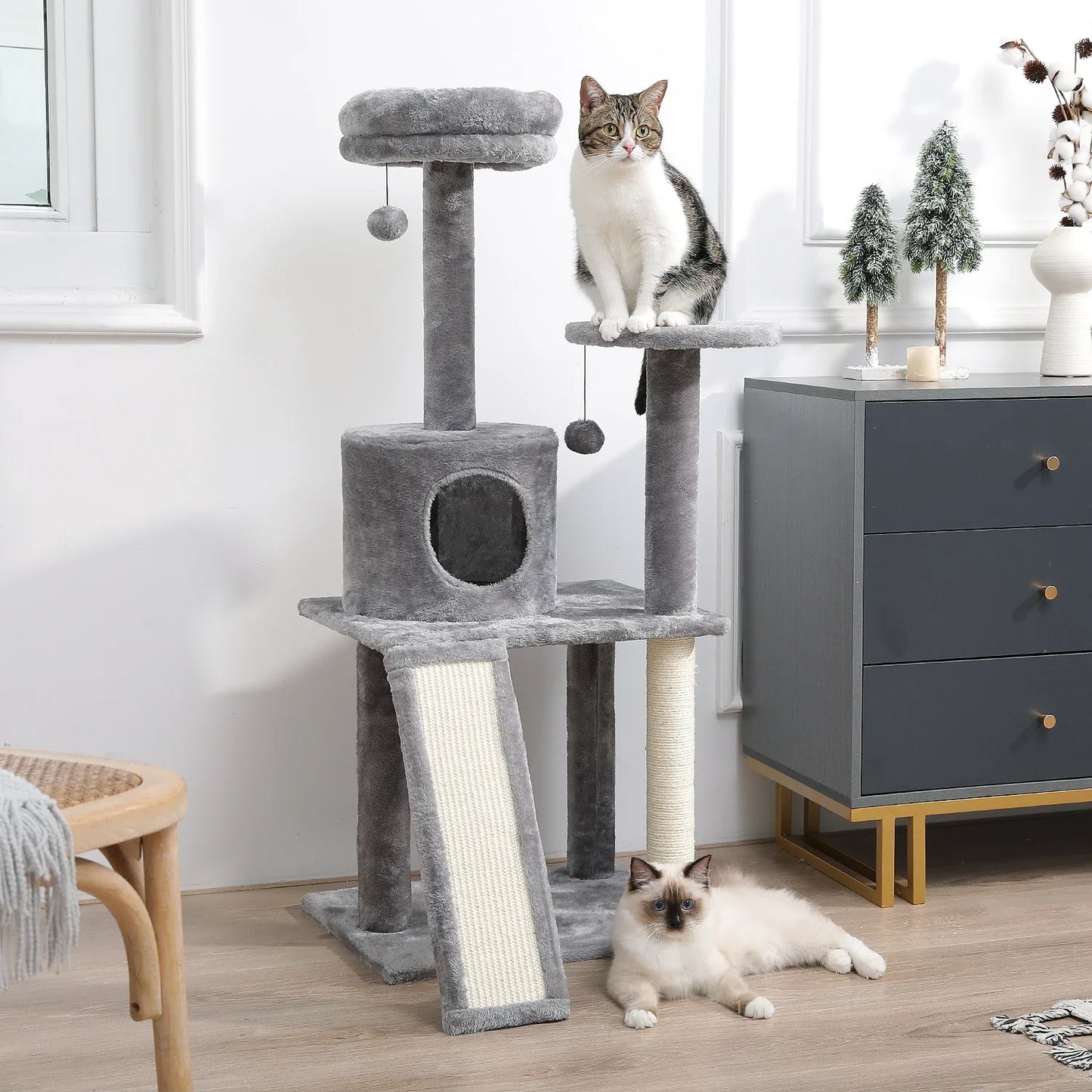
The 137cm cat tree tower with two condos, three scratching posts, two dangling balls, and a large cat house is a well-suited option for anxious cats, offering two enclosed spaces, multiple levels, and several scratching posts - covering the retreat, height, and territorial marking dimensions that are most relevant to anxiety reduction.
For households where a more minimal aesthetic is preferred, the 130cm modern minimalist-style designer edition cat tree provides solid construction and clean design in a form that doesn't visually dominate the room while still providing meaningful height and scratching surface.
For cats who are particularly cautious and benefit from lower access steps, the 99cm three-tier cat climbing tree with scratching post for kittens and cats offers a gentler graduated access structure that works well for cats who are less confident about large jumps.
The Cat Tree Haven large cat tree collection (100-200cm) covers the height range most suitable for anxious cats who benefit from genuine elevation, while the small cat tree range (under 100cm) includes options for smaller spaces or cats who are early in their acclimatisation to cat furniture.
Introducing a Cat Tree to an Anxious Cat
An anxious cat may not immediately approach or use a new cat tree, and this should be expected rather than taken as a sign that the tree isn't working. New objects in the environment can themselves be temporarily stressful for anxious cats, so a gradual introduction is worth planning for.
Position the tree near an area the cat already uses, rather than in an unfamiliar corner of the home. Add a familiar-smelling blanket or piece of clothing to one of the platforms to provide olfactory familiarity. Allow the cat to approach and investigate at their own pace without being directed toward the tree. Reward voluntary interaction - sniffing, touching, or rubbing against the tree - with calm acknowledgement or a small treat.
For cats who are very slow to accept new objects, leaving the tree in the intended location for several days before expecting use, and spending time nearby without focusing attention on the cat, can help it become part of the established environmental landscape before the cat commits to using it.
Our post on how to introduce a nervous cat to a new piece of cat furniture provides a step-by-step approach for this process that's specifically relevant for anxious or cautious cats.
A Note on Veterinary Support
Cat trees are a valuable environmental enrichment measure and can make a meaningful difference to the day-to-day stress levels of an indoor cat whose environment has been lacking in vertical territory, retreat spaces, and scratching outlets. However, they are not a clinical intervention and should not be used as a substitute for professional assessment when anxiety is significant, persistent, or affecting the cat's quality of life in a serious way.
If your cat's anxiety is severe - particularly if it involves aggression, compulsive behaviours, elimination outside the litter tray, or signs of physical distress - a veterinarian or veterinary behaviourist should be consulted. Environmental modification, including cat trees, is often recommended as part of a broader management approach, but the starting point for significant anxiety is always professional guidance.
For additional reading on this topic, our post on what veterinary research says about cat trees and mental health for indoor cats covers the evidence base in a measured, practical way.
Have Questions About Supporting Your Cat's Wellbeing?
If you're looking for guidance on which cat tree suits an anxious cat's specific needs, or if you have questions about features, sizing, or placement, our team at Cat Tree Haven is happy to help.
Get in touch with the Cat Tree Haven team and we'll help you find an option that's well-suited to your cat and your home.
Frequently Asked Questions
Can a cat tree really help with cat anxiety?
A cat tree addresses several environmental factors that are commonly linked to anxiety in indoor cats - specifically the absence of vertical territory, secure retreat spaces, and appropriate scratching surfaces. For cats whose anxiety is partly driven by environmental deficiency, providing these resources can contribute to a measurable reduction in stress-related behaviours. It is not a clinical treatment for anxiety and should not replace veterinary assessment for cats with significant or persistent anxiety.
What signs of anxiety in cats might a cat tree help with?
Environmental enrichment through a cat tree is most likely to help with stress-related behaviours that stem from insufficient vertical territory or retreat options - including furniture scratching, hiding in the same spot for extended periods, heightened reactivity, and reluctance to settle in main living areas. Behaviours with other causes, including medical causes, require professional assessment.
Where should I put a cat tree for an anxious cat?
For an anxious cat, position the tree near an area the cat already uses comfortably - near their existing favourite spot or near a window they look out from. Avoid placing it in a high-traffic area or near anything that startles the cat, such as a frequently used doorway or a noisy appliance. A position that allows the cat to observe the room from above while being near something familiar tends to work best.
Does the height of a cat tree matter for anxiety?
Yes. The anxiety-reducing effect of height is connected to the vantage point it provides - the ability to observe the environment from above and feel a greater sense of control over it. A very low cat tree may not provide enough elevation to deliver this effect meaningfully. For anxiety purposes, a tree that allows the cat to see across the room from above - typically 100cm or more for an average-sized room - is more effective than a compact structure.
How long does it take for a cat tree to help an anxious cat?
This varies considerably between individual cats. Some cats begin using a cat tree within days and show changes in behaviour within a few weeks. Anxious cats who take longer to accept new objects in their environment may take several weeks to begin using the tree at all, with behavioural changes following after that. Consistent placement, familiar scent on the tree, and a low-pressure introduction process tend to shorten this timeline.
Is an enclosed condo important for anxious cats?
Yes, particularly for cats whose anxiety involves a need to hide or retreat. An enclosed condo provides a combination of height and partial concealment that addresses two distinct aspects of the feline need for security during rest. For anxious cats in multi-animal homes or high-activity households, the enclosed condo is often the most consistently used feature of the cat tree. It should be a priority feature when selecting a tree for an anxious cat.
Should I get a cat tree for a cat with separation anxiety?
A cat tree can be a useful part of the environmental enrichment provided to a cat with separation anxiety, as it gives the cat meaningful activity options and a secure resting spot when alone. However, separation anxiety in cats is a specific condition that often benefits from a broader management approach including consistent routines, environmental enrichment, and in some cases veterinary support. A cat tree alone is unlikely to resolve significant separation anxiety, but it can be a helpful component of a wider strategy.