
Walk into the cat furniture section of any Australian pet retailer - or scroll through the options online - and the sheer variety can make even a simple purchase feel complicated. Cat trees range from a single sisal post with a perch bolted to the top, all the way to elaborate multi-level towers that stand nearly three metres tall and include hammocks, condos, climbing ladders, and enough sisal rope to keep a ship anchored. Somewhere between those two extremes is a right answer for your specific cat and your specific home.
The question of single-level versus multi-level is one of the most common we encounter at Cat Tree Haven. It sounds like a simple preference question, but it is actually worth thinking through properly - because the wrong choice can mean a perfectly good piece of cat furniture that your cat largely ignores. Here is a thorough guide to how these two categories differ, what each does well, and how to match the choice to your cat.
Defining the Categories
Before comparing them, it helps to be clear about what "single-level" and "multi-level" actually mean in practical terms.
Single-level cat furniture includes options like a standalone scratching post with one perch, a simple cat scratcher with a single resting platform, or a compact tree with one primary elevated spot. The defining characteristic is that there is one main activity zone at height. Some of these options include a scratching post, a dangling toy, and a single perch - enough to satisfy a basic scratch-and-rest need, but not offering meaningful progression or multiple distinct zones.
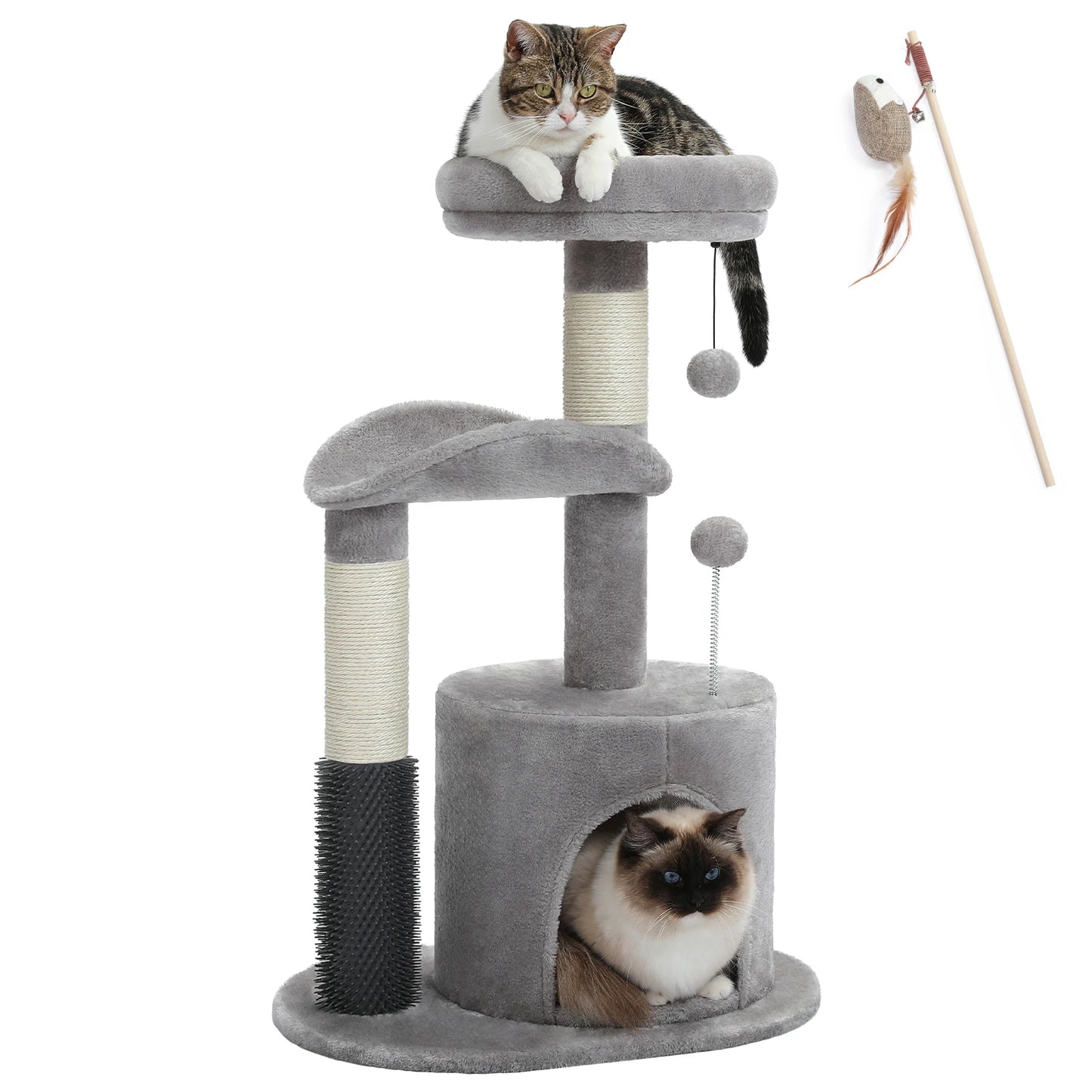
Multi-level cat trees include two or more distinct platforms at different heights, often combined with features like an enclosed condo, a hammock, a top perch, and sisal posts distributed across the structure. The defining characteristic is variety: different levels serve different functions - active climbing, resting, observing, hiding - and different cats in the household can occupy different levels simultaneously.
The distinction matters because these two types meet meaningfully different needs, not just different aesthetic preferences.

What Single-Level Options Do Well
There is a tendency to frame single-level cat furniture as the budget or compromise option, but that framing is not quite right. There are specific situations where a simpler structure is genuinely the better choice, not just the cheaper one.
For kittens still developing coordination. A young kitten working out how to navigate a new environment does not need the complexity of five platforms at different heights. A lower, simpler structure where the distances between surfaces are manageable is safer and helps build confidence rather than creating early hesitation. As the kitten grows and their coordination develops, you can graduate to something more complex.
For older or less mobile cats. Senior cats with joint stiffness or reduced agility may have no interest in a multi-level tower that requires repeated jumping between platforms. A single elevated perch at a comfortable height - accessible without a demanding jump - may be exactly what they need. The goal is a resting spot at height, not a climbing challenge. Our post on what senior cats need from cat furniture covers this in more depth.
For genuinely constrained spaces. In a very small apartment or a room where floor space is limited, a compact single-perch option or a standalone scratching post takes up significantly less room than a multi-level tower. If the alternative is fitting a multi-level tree awkwardly into a space it does not suit, a well-chosen compact option is often more practical.
As a secondary or supplementary piece. A household that already has a well-used multi-level tree may add a compact scratching post or single-perch option in a different room for convenience - near a window in the bedroom, for example, or in a study where the cat spends time but the main tree would be out of place.
For timid or recently rescued cats. A cat that is nervous about a new environment may find a complex multi-level structure initially overwhelming. Starting with something simpler, allowing the cat to build confidence, and then graduating to a more complex structure is a legitimate approach for some temperaments.
What Multi-Level Trees Offer That Single Options Cannot
The case for multi-level cat trees rests on a straightforward behavioural reality: cats are explorers by nature, and a single elevated spot addresses only the endpoint of a climbing sequence rather than the sequence itself.
Physical exercise and activity. Moving between levels - jumping from platform to platform, climbing between different heights - is active physical exercise. For indoor cats that do not have the running, climbing, and hunting opportunities of an outdoor life, this built-in movement is genuinely valuable for maintaining muscle tone, coordination, and a healthy weight. A single perch gives the cat somewhere to arrive; a multi-level tree gives them a journey to take.
Variety of activity zones. A well-designed multi-level tree functions almost like a set of rooms, each serving a different purpose. The enclosed condo is for privacy and rest. The hammock is for semi-exposed lounging. The top perch is for observation. The sisal post is for scratching and stretching. A cat moving through their day will use each of these for different purposes at different times. A single-level option can only serve one or two of these functions simultaneously.
Territory expansion for multi-cat homes. When two cats share a home, territorial tension is almost inevitable without adequate spatial separation. A multi-level tree creates vertical zoning - one cat can occupy the top perch, another can rest in the condo, and they are not directly competing for the same position. A single-level option with one perch creates a single desirable spot that one cat will claim and the other will be excluded from. This can actually intensify rather than reduce territorial tension.
Mental enrichment. The variety and height of a multi-level tree provides more environmental stimulation than a single perch. Different heights offer different views. Different zones engage different instincts. Cats in environments that provide more varied stimulation tend to show fewer signs of boredom-related behaviour like over-grooming, excessive vocalisation, or redirected destructive activity.
How to Decide: The Key Questions
Rather than recommending one category categorically over the other, here is a practical decision framework.
How many cats do you have? If you have two or more cats, a multi-level tree with multiple distinct zones is significantly more appropriate for managing territorial dynamics. A single-level option in a multi-cat home is likely to become contested territory rather than shared space.
How active is your cat? An energetic young adult cat that runs, jumps, and climbs throughout the day will be more engaged by a multi-level structure with room to move between platforms. A more sedentary cat or a senior cat is better matched to something simpler and more accessible.
How much floor space do you have? This is an honest practical constraint. A tall multi-level tower requires a stable footprint that suits the home. If the space available genuinely cannot accommodate a multi-level tree, a quality compact option is better than a multi-level tree wedged into an unsuitable spot.
What is the cat's life stage? Kitten - start simpler and graduate. Young adult in their prime climbing years - multi-level is the better choice for sustained engagement. Senior cat - simpler and lower access is more appropriate.
Is your cat primarily indoors? Fully indoor cats derive more of their physical activity and mental stimulation from their home environment than cats with outdoor access. For an indoor-only cat, a multi-level tree is meaningfully more important because it is doing more enrichment work.
Product Examples Across Both Categories
At Cat Tree Haven, our range includes options across both categories. Here are a few that illustrate the spectrum well.
On the simpler end, our cat scratching post with sisal board, interactive toy balls, and sturdy wood base is a compact, focused option that provides sisal scratching and interactive play elements without the complexity of a multi-level structure. It suits households where scratching redirection is the primary goal, where space is limited, or where a secondary piece is needed in a room where a larger tree would not fit.
The 99cm three-tier cat climbing tree with scratching post sits at the transition point - three levels within a moderate height, making it suitable for kittens developing their climbing confidence, smaller cats, or households where a full-scale multi-level tower is more than is needed. It provides genuine vertical progression without the physical demands of a tall, widely-spaced multi-level structure.
At the fuller end of the multi-level spectrum, the 162cm multi-level cat tree with condo, cat scrapers, and hammock offers the complete range of activity zones - an enclosed condo, a hammock, multiple scratching posts, and distinct platforms at genuinely different heights. This is the kind of structure that makes a meaningful difference for an active adult cat or a multi-cat household, providing enough variety and vertical range to serve different functions throughout the day.
For those looking at the broader range to compare options across heights and configurations, our large cat tree collection from 100cm to 200cm covers the majority of multi-level options suited to active adult cats and multi-cat homes in Australian households. And our tall multi-level cat tower collection covers the taller, more vertically oriented structures for active climbers and larger homes.
The Honest Answer
Single-level options are not inferior - they are appropriate for specific situations. Multi-level trees are not always necessary - they are better matched to active, curious cats in environments where enrichment matters.
For most Australian households with one or two adult cats who spend most of their time indoors, a multi-level tree with multiple distinct zones will serve the cat's physical and behavioural needs better than a single-level option over the long term. But if the primary need is scratching redirection, a small supplementary piece for a second room, or a more accessible option for a senior cat, a simpler structure may be the right call.
The goal is always a match between the cat's actual needs and what the tree provides - not simply the most complex or the most affordable option available.
If you are still not sure which direction suits your cat and your home, Cat Tree Haven is happy to help you work through it.
Get in touch with our team here and we will point you toward something that genuinely fits.
Frequently Asked Questions
Is a single-level cat tree enough for one cat?
It depends on the cat's age, activity level, and how much time they spend indoors. For a senior or less active cat, a single-level option with a comfortable perch and a scratching post may be sufficient. For a young, active indoor cat, a multi-level structure provides meaningfully more physical exercise and mental stimulation.
Do cats actually use all the levels of a multi-level cat tree?
Usage patterns vary between individual cats and often change over time. Many cats develop preferences for specific levels and rotate between them depending on the time of day and their activity state. A cat is more likely to use multiple levels if the tree is well-placed, stable, and offers distinct features at different heights rather than just open platforms.
What is the main advantage of a multi-level cat tree over a single perch?
A multi-level tree provides variety - multiple activity zones that serve different functions (climbing, resting, hiding, observing, scratching) - and vertical progression that engages a cat's natural climbing instincts. A single perch provides a resting spot at height, which meets the need for elevation but does not offer the same physical activity or enrichment.
Which type of cat tree is better for a two-cat household?
A multi-level tree is generally more appropriate for a two-cat household because it provides multiple distinct zones that different cats can occupy simultaneously without competing for the same position. A single-level option with one perch creates a single contested spot, which can intensify rather than reduce territorial tension.
Can a single-level cat tree replace a multi-level one?
For some cats and some situations, yes. For an active indoor adult cat, a single-level option is unlikely to provide the same level of physical exercise and enrichment that a multi-level structure offers. For a senior cat or a kitten still building confidence, a single-level option may be more appropriate than a complex multi-level structure.
Are multi-level cat trees harder to assemble?
Generally yes, as they involve more components. Most multi-level trees from reputable retailers include clear assembly instructions and the necessary hardware, and most owners find the process manageable. The assembly time is typically longer than for a single-level option, but the structural complexity once assembled is what gives the tree its value.
What height is ideal for a single-level cat tree perch?
This depends on the cat. For an adult cat in good health, a perch at 60 to 90cm provides a meaningful vantage point without requiring a difficult jump from floor level. For an older or less mobile cat, 40 to 60cm may be more accessible. For a kitten, a lower perch of 40 to 60cm is safer as their coordination is still developing.