
At Cat Tree Haven, we regularly hear from cat owners who notice meaningful behavioural changes after introducing a cat tree into their home. Cats that once hesitated to leave hiding spots start resting out in the open. Curious exploration replaces nervous pacing. These shifts are rarely coincidental. They are closely linked to how confident and secure a cat feels within their environment.
Confidence in cats is not about bold or dominant behaviour. It is about feeling safe enough to explore, rest, and engage without fear. A well-designed cat tree supports this by aligning with natural feline instincts such as climbing, observing from height, and choosing when to interact. When these needs are met, confidence develops naturally over time.
Key takeaways
- Confidence in cats grows when they feel safe and in control of their surroundings
- Vertical space allows cats to observe without feeling threatened
- Cat trees support independence, especially for indoor cats
- Gradual climbing and resting zones encourage emotional balance
- Choosing the right structure and placement matters for long-term confidence
What confidence looks like in cats
Confident cats move through their environment comfortably. They explore new spaces, recover quickly from minor stress, and interact more calmly with people and other pets. Cats with lower confidence may hide frequently, avoid certain areas, or react defensively to everyday situations.
Environmental factors play a significant role here. Indoor cats, in particular, rely entirely on their home setup for stimulation and reassurance. Without enough structure or territory, even relaxed cats can become unsure over time.
At Cat Tree Haven, we approach cat furniture as a way to shape the environment rather than the cat. When the space supports natural behaviour, confidence follows.
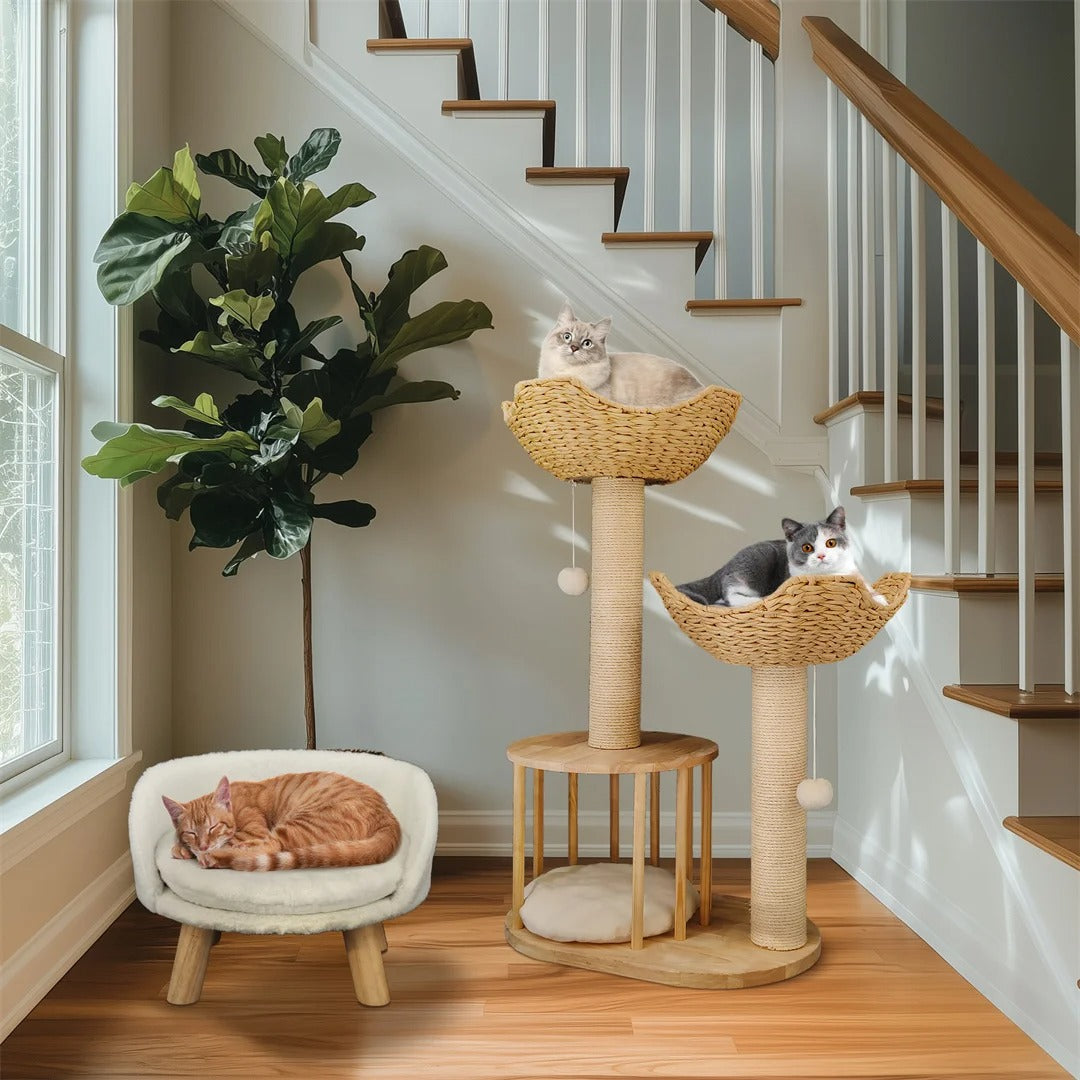
Why height helps cats feel secure
Cats instinctively seek elevated positions. In nature, height provides visibility and a sense of safety. Domestic cats retain this instinct, even in indoor settings.
Cat trees provide raised platforms that allow cats to:
- Observe household activity without being directly involved
- Retreat upward instead of hiding underneath furniture
- Control their proximity to people and other animals
This ability to choose distance is key to confidence building. When cats know they can remove themselves from a situation without feeling trapped, they are more likely to remain calm and curious.
How cat trees support gradual confidence building
Confidence develops through repeated positive experiences. Cat trees help by offering structure and predictability, which are especially important for nervous or newly adopted cats.
Safe, controlled exploration
Cat trees encourage movement in stages. Platforms, steps, and perches allow cats to pause or retreat whenever they choose. This is far less overwhelming than open floor space and helps cats explore at their own pace.
This principle is closely connected to the physical benefits discussed in our guide on how cat trees promote healthy exercise for indoor cats, where movement and confidence work together.
A sense of personal territory
Cats feel more secure when they have a space that belongs to them. Over time, a cat tree becomes familiar in scent and routine. It turns into a reliable place to rest, watch, and reset.
This sense of ownership supports emotional stability, particularly in busy households or smaller homes where floor-level territory is limited.
Confidence and balance in multi-cat households
In multi-cat homes, confidence can be influenced by competition for space. Without enough separation, even cats that usually get along can feel unsettled.
Vertical territory reduces this pressure by allowing cats to share rooms without sharing the same level. Taller designs from our extra large cat tree collection offer multiple resting and observation points, helping each cat feel secure without conflict.
This approach aligns with the behaviour patterns explored in our article on the impact of cat trees on feline behaviour, which highlights how environment influences interaction.
The link between movement and emotional confidence
Physical confidence often supports emotional confidence. When cats climb, balance, and jump on stable structures, they learn what their bodies can do. This builds trust in their own movement.
Cat trees provide predictable surfaces designed for climbing. Unlike household furniture, they reduce uncertainty and allow cats to practise movement without unnecessary risk. Over time, this can translate into calmer, more assured behaviour throughout the home.
Resting spaces and emotional security
Confidence is not built through activity alone. Rest and recovery are just as important. Cats need places where they can relax while still feeling aware of their surroundings.
Many cat trees include enclosed condos alongside open platforms. This combination allows cats to choose between privacy and visibility depending on how they feel at any given moment.
A balanced design like the 142cm large solid natural wood cat tree with condo and scratching post offers this flexibility and supports both rest and observation.
Supporting confidence in indoor cats
Indoor cats experience the world entirely through their home environment. Without outdoor territory, enrichment becomes essential for both mental and emotional wellbeing.
Cat trees add vertical complexity that helps prevent boredom and frustration. When placed near a window, they also provide visual stimulation, which can support curiosity and calm behaviour.
This connection between environment and emotional wellbeing is explored further in our resource on why cat trees are essential for your cat’s mental health.
Choosing the right cat tree for confidence building
Not all cat trees support confidence equally. The right option depends on a cat’s age, size, and temperament.
General considerations include:
- Stability and gradual levels for timid or older cats
- A mix of open perches and enclosed resting spaces
- Solid materials that feel secure underfoot
For many households, options within our large cat tree range provide a good balance between height, accessibility, and stability.
Cats that already enjoy climbing may benefit from taller, more complex structures, while cautious cats often respond better to mid-height designs.

Placement plays a key role
Even the best cat tree may be underused if placed poorly. Cats usually prefer locations where they can observe activity without being in the centre of it.
Quiet corners with a view of the room or near windows tend to work well. Avoid placing cat trees in high-traffic areas where sudden movement or noise may cause stress.
Thoughtful placement reinforces the cat tree as a safe and predictable space, which supports confidence over time.
Building confidence with Cat Tree Haven
At Cat Tree Haven, our focus is on creating environments where cats can feel secure, capable, and at ease. Confidence is not something that can be forced. It grows when cats are given the right tools and the freedom to use them in their own way.
You can explore our full range at Cat Tree Haven or speak with our team through our contact page if you would like guidance on choosing the right setup for your cat.
Frequently asked questions
Can cat trees help shy or nervous cats?
Yes. Vertical space allows cats to observe their surroundings without feeling threatened, which often supports gradual confidence building.
How long does it take for a cat to gain confidence using a cat tree?
This varies by cat. Some adapt quickly, while others may take several weeks of consistent access.
Are tall cat trees suitable for all cats?
Not always. Older cats or those with limited mobility may benefit more from mid-height designs with gradual levels.
Do kittens build confidence using cat trees?
Kittens often gain confidence quickly through climbing and play, provided the structure is stable and age appropriate.
Can cat trees reduce anxiety-related behaviours?
They can help by providing safe territory and structured activity, which may reduce stress-related behaviours in some cats.
Is one cat tree enough for a multi-cat home?
It depends on the size and layout. Larger trees with multiple resting areas often work better for shared spaces.
Where should a cat tree be placed for best results?
Quiet areas with good visibility, such as near windows or calm living spaces, usually support confidence most effectively.