
Key Takeaways
- Wall-mounted cat shelves use zero floor space but require permanent wall fixings, making them less suitable for renters without landlord permission
- Cat trees use floor space but require no installation and can be repositioned or moved between homes without any wall remediation
- The space-saving advantage of wall shelves is real but conditional - it only applies when wall space is genuinely available and fixings are permitted
- Cat trees in slim, tall configurations can occupy a surprisingly small footprint while still providing meaningful vertical territory
- The most space-efficient solution for many homes is a combination of both - a compact cat tree as the primary structure with wall-mounted pieces in secondary locations
- Cost, installation complexity, and flexibility all factor into the comparison alongside raw floor space savings
- Cat Tree Haven stocks both freestanding cat trees and wall-mounted cat furniture, with free shipping across Australia
Space is one of the most common constraints that cat owners face when choosing furniture for their cats. In a typical Australian apartment or smaller home, every square metre of floor space carries real value. A large cat tree taking up a corner of the living room is a genuine compromise, and it's reasonable to question whether there's a more space-efficient way to give your cat the vertical territory they need.
Wall-mounted cat shelves are the obvious answer to that question, and they genuinely do save floor space. But the comparison between wall shelves and cat trees isn't quite as simple as "shelves use wall space, trees use floor space, therefore shelves win." There are practical considerations around installation, rental suitability, cost, flexibility, and what actually works for your cat that make this a more nuanced decision than it first appears.
This guide works through the comparison honestly so you can make a clear-headed decision based on your specific situation rather than assuming one is better than the other on principle.

The Core Space Equation
The starting point for this comparison is understanding exactly what kind of space each option uses.
A freestanding cat tree occupies floor space through its base. The footprint of the base - typically somewhere between 40x40cm for a compact design and 70x70cm or larger for a heavy multi-level structure - is permanently occupied while the tree is in place. Everything above the base uses vertical air space rather than floor area, which is part of why tall, narrow cat trees can be more space-efficient than they initially appear.
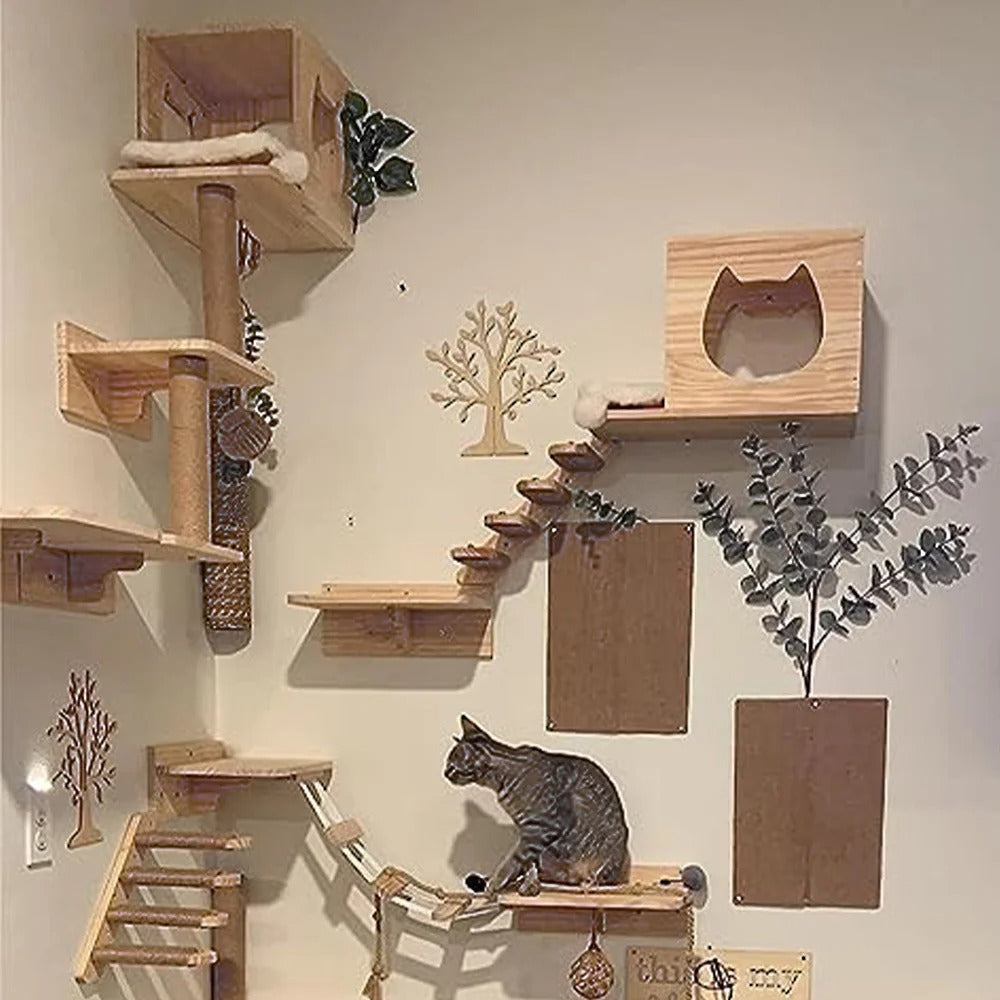
Wall-mounted cat shelves occupy no floor space at all. Each shelf is fixed directly to the wall, and the only physical footprint at ground level is the slight protrusion of the bracket, which is negligible. A full climbing route of six to eight wall-mounted shelves running across a wall uses the same floor area as nothing - literally nothing beyond the wall surface itself.
This is the strongest case for wall-mounted cat furniture from a pure space perspective, and it's a compelling one in environments where every square metre matters. However, this advantage only materialises in full when the following conditions are met: there is adequate wall space available in the right location; the wall construction can support the fixings; and drilling into the walls is permitted.
When any of these conditions aren't met, the floor-space-saving advantage of wall shelves becomes either impossible to access or practically complicated to achieve.
The Installation Requirement: What It Actually Involves
This is the factor that most significantly limits the applicability of wall-mounted cat furniture for Australian cat owners, a significant proportion of whom rent rather than own their homes.
Installing wall-mounted cat shelves requires drilling into the wall to place brackets or fixings. The fixings need to be appropriate for the wall construction - timber framing, masonry, or concrete - and should be located in structural material rather than just plasterboard, which doesn't hold dynamic load reliably. Getting this right requires either confidence with basic construction tasks and access to the right tools, or willingness to pay someone else to do it.
For renters, the issue is more fundamental. Most standard residential leases in Australia restrict tenants from making holes in walls beyond what's considered minor and acceptable - a category that typically covers small picture hooks but not structural brackets for cat furniture. Installing wall shelves in a rental property without landlord permission creates a potential liability at the end of the tenancy for wall remediation. Getting permission, in advance and in writing, is the appropriate approach for renters who want to go this route - but not all landlords will agree, and the process adds friction that freestanding cat trees simply don't have.
A freestanding cat tree requires no drilling, no wall assessment, no landlord conversation, and no remediation at the end of a tenancy. You place it, use it, and take it with you when you go. For a renter who moves regularly - which describes a significant portion of Australian urban renters - this portability and lack of permanence is a genuine practical advantage that the floor space cost doesn't fully cancel out.
Space Efficiency Within the Cat Tree Category
One nuance worth addressing is that "cat tree" is a broad category covering an enormous range of footprint sizes. The image of a cat tree as a large, sprawling structure that dominates a room is accurate for some products - wide multi-level structures with large bases can occupy meaningful floor area. But it's not accurate for the full range.
Slim, tall cat trees designed with a compact base and vertical orientation can have a remarkably small floor footprint. A well-designed tree that rises to 150cm from a 40x40cm base is occupying less floor space than many standing lamps or side tables while providing meaningful vertical territory for a cat. In a small apartment, a slim cat tree positioned in a corner uses space that would likely otherwise be unoccupied anyway.
The 97cm Scandinavian-style cat tree is a good example of a design that keeps the footprint genuinely compact while delivering functional height and a scratching post. It sits in a corner without dominating the visual field of the room or blocking movement through the space.
For a taller option with the same space-conscious approach, the 110cm modern wooden cat tree with scratching post and stylish climbing tower provides more vertical range in a clean natural wood design that integrates visually without feeling like an imposition on the room.
The floor-space cost of a compact cat tree placed in a corner is much less significant than it might initially seem, and it's worth doing an actual measurement exercise before concluding that floor space is genuinely the limiting factor in your home.
What Wall Shelves Do Well
With the installation caveat clearly noted, wall-mounted cat furniture genuinely excels in specific situations where the conditions are right.
In a home that is owner-occupied, where drilling is freely permitted, wall shelves provide the most space-efficient climbing route available. They use wall area that would otherwise sit completely empty - the 2m of wall between the bookcase and the window, for example - and transform it into functional cat territory without reducing the usable floor area at all.
Wall shelves are also the most customisable option for creating a specific climbing route. The sequence, spacing, height, and direction of the climbing path can be designed to suit the specific room, the specific cat's jumping ability, and the owner's aesthetic vision. This level of configuration isn't possible with a freestanding cat tree, which arrives in a fixed design.
For cats who are particularly active climbers, or for rooms where a creative climbing environment is a genuine priority, wall-mounted furniture provides possibilities that freestanding trees don't.
The wall-mounted wooden cat bridge is a good example of a wall-mounted piece that functions as part of a broader climbing route while using minimal space. It can be combined with other wall-mounted elements to create a connected path across a wall without any floor presence at all.
The Cat Tree Haven wall-mounted cat furniture collection covers the range of shelves, platforms, hammocks, and ladders that can be combined in different configurations to suit different rooms and different cats.
Cost Comparison: More Than Just the Purchase Price
The sticker price comparison between wall shelves and cat trees doesn't tell the complete cost story.
Wall-mounted cat shelves are often individually priced at a moderate cost, but building a complete climbing route from multiple separate pieces adds up. Adding a shelf, a hammock, a platform, and a ladder or two to create a functional climbing sequence involves purchasing four or more separate products. The total cost of a complete wall-mounted setup is often comparable to or higher than a mid-range freestanding cat tree that integrates all of those features in one structure.
There are also installation costs to consider for owners who aren't comfortable installing wall fixings themselves, and potential remediation costs for renters who need to fill and repaint holes at the end of a tenancy.
Cat trees present their full cost up front in the purchase price, with no additional installation or remediation costs and no need to purchase multiple separate pieces to create a complete environment.
This doesn't make cat trees the cheaper option in every scenario, but it makes the cost comparison more nuanced than a simple price-per-unit comparison suggests.
What Actually Works Best for Your Cat
Space efficiency matters to the owner. What works best for the cat depends on different factors.
Cats who are confident, active climbers tend to use both wall shelves and cat trees readily, provided the structures are positioned in locations that serve their territorial and observation needs. The surface type and height matter more than the structural format for these cats.
Cats who are anxious or more cautious tend to benefit more from cat trees that include enclosed condos, because the combination of height and enclosure serves their retreat needs in a way that open wall shelves don't. A wall shelf provides an elevated perch but not a concealed resting spot. For an anxious cat, the enclosed condo on a cat tree is a meaningful welfare feature that wall shelves typically don't replicate.
Cats in multi-cat households benefit from having vertical territory distributed around the home rather than concentrated in one location. A cat tree in the main living area plus a wall shelf or two in secondary rooms provides more distributed territory than either option alone - which is often the most effective approach for reducing inter-cat tension.
Our post on how vertical territory helps reduce stress and anxiety in indoor cats covers the welfare dimension of this in more depth, including the specific benefits of enclosed retreat spaces that wall shelves alone don't provide.
The Practical Recommendation: Often Both
For many households, the most useful answer to the wall shelves vs cat trees question is not either/or. A compact freestanding cat tree as the primary structure - positioned in the main living area where the cat spends most of their time - combined with one or two wall-mounted pieces in other areas of the home, provides the most complete solution.
The cat tree gives the cat a fully featured vertical environment with scratching posts, multiple levels, and potentially an enclosed condo, in the central room of the home. The wall pieces in secondary rooms - a shelf near a bedroom window, a bridge along a hallway wall - create additional territory zones without requiring a second full cat tree in each space.
This approach manages floor space across the home more effectively than a single large cat tree in one room, and more practically than an all-wall-mounted setup that requires full installation approval throughout the home.
The wall-mounted cat wooden climbing shelves with cat hammock, ladder, and jumping platform works well as a supplementary wall installation in a bedroom or secondary room, providing a hammock and elevated resting spot without requiring a full cat tree footprint.
For the primary structure, the small cat tree collection (under 100cm) offers compact options that work in tight spaces while still providing the features that wall shelves alone don't deliver.
Our post on whether a freestanding or wall-mounted approach better suits different Australian home types covers the space-saving comparison from a different angle and is worth reading alongside this guide if you're still weighing up which direction to prioritise.
Have a Question About Which Option Works for Your Home?
If you're working with a specific room layout and not sure which approach makes the most sense for your cat and your space, our team at Cat Tree Haven is happy to help you think through it.
Get in touch with the Cat Tree Haven team and we'll help you find the right solution for your home.
Frequently Asked Questions
Do wall cat shelves really save more space than cat trees?
Wall-mounted cat shelves use no floor space, which is their primary space-saving advantage over freestanding cat trees. However, this advantage depends on having suitable wall space available, wall construction that can support fixings, and permission to drill - which is a significant restriction for renters. Compact cat trees in tall, narrow designs can have a surprisingly small floor footprint, particularly when positioned in corners. The space-saving advantage of wall shelves is real but conditional.
Can I use wall-mounted cat shelves in a rental property?
Possibly, but this requires landlord permission in most cases. Standard residential leases in Australia typically restrict tenants from making structural holes in walls without consent. Installing wall shelves without permission creates a potential liability for wall remediation at the end of the tenancy. If permission is granted in writing, wall shelves can work in a rental property. If not, a freestanding cat tree is the more practical choice because it leaves no marks and can be removed completely when you vacate.
Which is better for an anxious cat - wall shelves or a cat tree?
For anxious cats, a cat tree with an enclosed condo provides something that wall shelves typically don't: a combination of height and enclosure that serves the retreat function. Open wall shelves provide elevated perches for observation but don't give an anxious cat the concealed resting space that reduces vulnerability during rest. If anxiety is a factor, a cat tree with a condo is generally the more complete solution.
How much wall space do I need for a cat shelf climbing route?
A functional climbing route using wall-mounted shelves typically requires a continuous run of wall at least 1.5 to 2 metres wide to allow comfortable spacing between pieces. The steps need to be within a jumping distance appropriate for your cat - generally 30 to 50cm between each platform for an adult cat of average ability. Vertical height between 60cm and 200cm from the floor is typically the useful range. Specific spacing requirements depend on the size and agility of the individual cat.
Are wall cat shelves or cat trees more expensive overall?
Individual wall shelves can be moderately priced, but building a complete climbing route from multiple separate pieces adds up and often totals as much as or more than a mid-range freestanding cat tree. Cat trees present their full cost at the point of purchase with no installation or remediation costs. The total cost comparison depends on how many wall pieces are needed to create a functional route and whether installation costs are involved.
Can I combine wall shelves and a cat tree in the same home?
Yes, and this is often the most effective approach. A freestanding cat tree in the main living area provides a complete vertical environment with scratching posts, multiple levels, and potentially an enclosed condo. Wall-mounted pieces in secondary rooms - a bedroom, a hallway, a study - create additional territory zones without requiring a full cat tree in each space. This combination provides the most distributed vertical territory while managing floor space efficiently across the home.
How do I mount cat wall shelves safely?
Cat wall shelves should be fixed into wall studs, timber noggins, or solid masonry using fixings appropriate for the load and wall type. Fixing into plasterboard alone without backing is not adequate for the dynamic load of a cat jumping onto a shelf. Using a stud finder before drilling helps locate structural timber behind plasterboard walls. The weight rating of the fixings and brackets should exceed the weight of the heaviest cat who will use the shelf, with a meaningful safety margin. If you're not confident assessing your wall type or locating studs, consulting a qualified tradesperson before installing is a sensible step.