
Key Takeaways
- Cats are instinctive climbers - the drive to seek height is rooted in survival behaviours that predate domestication by thousands of years
- Height gives cats a vantage point for monitoring their environment, which reduces anxiety and supports a settled, confident temperament
- In multi-cat households, vertical space functions as social territory - different heights allow cats to establish hierarchy without direct confrontation
- Indoor cats who lack access to height are more likely to show stress-related behaviours, including excessive vocalisation, destructive scratching, and hiding
- Providing structured climbing options like cat trees directly supports your cat's natural behavioural needs
- Cat Tree Haven stocks a wide range of cat trees and towers designed to give indoor cats genuine vertical territory, with free shipping across Australia
If you've ever wondered why your cat ignores the comfortable bed you bought at floor level and instead makes straight for the top of the wardrobe, the refrigerator, or the highest shelf in the room, you're not alone. It's one of the most consistently puzzling things about cats for owners who haven't come across the explanation before. The cat has a perfectly good sleeping spot. Why does it always end up somewhere inconvenient and impractical?
The short answer is that height isn't impractical from a cat's perspective. It's one of the most practical places they can be. The behaviour has deep roots in how cats evolved, how they process their environment, and how they manage their own stress and safety. Understanding why cats climb doesn't just explain an endearing quirk - it reveals something genuinely important about what cats need to thrive indoors.

It Starts With Instinct, Not Habit
Domestic cats share the vast majority of their behavioural instincts with their wild ancestors and with the wild cats that still exist today. Small wild felids - including the African wildcat, which is the primary ancestor of the domestic cat - are both predators and prey. They hunt small animals, but they are also vulnerable to larger predators. This dual position in the food chain shaped the behavioural strategies that cats use to manage risk.
Height is central to that strategy. A cat in an elevated position has an unobstructed view of the surrounding environment. It can see approaching threats from a distance, identify prey movement below, and assess the safety of a space before descending into it. It's also physically harder for most ground-based predators to reach. From an evolutionary standpoint, the instinct to seek height when possible is a well-tested risk management behaviour, not a quirk.
This instinct doesn't disappear in a domestic setting. A cat living in an Australian home has been domesticated for thousands of generations, but the underlying drive to seek elevated positions remains intact. When your cat climbs to the top of the wardrobe, they're not doing something random - they're doing exactly what their instincts are directing them to do.
The Vantage Point Instinct and Why It Matters Indoors
The concept of a vantage point is central to understanding cat behaviour around height. A vantage point is an elevated position that provides a broad, unobstructed view of the surrounding space. For cats, having access to a reliable vantage point is closely connected to how settled and secure they feel in their environment.
Research in cat behaviour consistently links access to elevated resting spots with reduced stress indicators in indoor cats. A cat who can observe their environment from above - who can see the door, monitor movement in the room, and maintain awareness of what's happening around them without needing to be in the middle of it - tends to be calmer and more relaxed than a cat who is confined to ground-level spaces.
This matters practically for indoor cat owners. An indoor cat has no access to the trees, fences, and rooftops that would provide natural vantage points outside. If the indoor environment offers no elevated options, the cat will typically find them anyway - by climbing furniture, bookshelves, or whatever else provides height. The drive doesn't go away; it just redirects toward whatever's available.
Providing structured, designed climbing options is the most effective way to meet this need without your cat treating your bookshelves as a personal cat tree. Our post on the connection between vertical space and your cat's confidence and wellbeing explores this relationship in more depth.
Height as Social Territory in Multi-Cat Households
In single-cat households, the height instinct is primarily about safety and observation. In multi-cat households, height takes on an additional social function.
Cats establish social hierarchies, and those hierarchies have a vertical dimension. The cat who occupies the highest point in a shared environment is typically the most socially dominant. Lower-ranking cats tend to occupy lower positions. This vertical spacing allows cats to express and reinforce social relationships without needing to engage in direct confrontation - which is important because cats, unlike some other social animals, are not well-equipped to resolve conflict through prolonged physical competition.
In practical terms, this means that a multi-cat household with no vertical territory is a household where conflict is more likely. If there's only one high spot - the top of the wardrobe, for instance - and multiple cats competing for it, the result is repeated confrontation over that single resource. Distributing vertical territory through a cat tree with multiple levels, or through a combination of cat furniture at different heights around the home, gives each cat meaningful territory without forcing them into constant competition.
This is one of the clearest practical reasons why multi-level cat trees are particularly valuable in homes with more than one cat. The height isn't just enrichment - it's social infrastructure.
The Safety Function: Why Cats Rest Up High
Beyond active observation, height serves a safety function during rest. Cats sleep for extended periods - sometimes 12 to 16 hours per day - and during sleep they are vulnerable. Resting at height reduces vulnerability in two ways: it removes the cat from ground-level threats, and it provides a clear line of sight if something approaches during lighter sleep phases.
This explains why cats who have access to elevated sleeping spots often seem to sleep more soundly and wake less anxiously than cats confined to ground-level beds. The elevated position gives the nervous system a degree of reassurance that ground-level sleeping doesn't provide, even in a fully safe domestic environment. The brain is still running the same underlying safety software that evolved over thousands of years.
It also explains why enclosed elevated spaces - a condo or a cave-style perch partway up a cat tree - tend to be popular resting spots, particularly for anxious or less confident cats. The combination of height and enclosure addresses both the safety and the vulnerability aspects of rest simultaneously.
What Happens When Cats Can't Access Height
Indoor cats who have no access to elevated positions don't simply adapt to ground-level living without consequence. The instinctive drive to seek height doesn't disappear - it either finds an outlet or contributes to stress.
Common signs that a cat is lacking adequate vertical territory include increased destructive scratching (which can also be a territorial behaviour connected to feeling insecure), excessive hiding, heightened reactivity to noise or movement, and in some cases increased conflict with other cats or people in the household. These behaviours aren't random - they're often connected to an environment that isn't meeting the cat's fundamental needs.
Providing appropriate climbing options is one of the more reliably effective adjustments an indoor cat owner can make to improve their cat's overall behaviour and temperament. It doesn't require a large space or an expensive setup. Even a well-positioned cat tree near a window can make a meaningful difference to how settled and secure an indoor cat feels day to day.
Our post on how cat towers help reduce boredom and anxiety in indoor cats covers the behavioural dimension of this in more detail, including what to look for if you think your cat may be showing signs of environmental stress.
Choosing the Right Climbing Option for Your Cat
Understanding why cats climb is only useful if it informs what you provide. The practical takeaway is that cats benefit most from elevated options that offer genuine height, a stable surface to rest on, and ideally a clear view of the room below.
A cat tree positioned near a window is particularly effective because it combines height with visual stimulation from the outside world. Most indoor cats spend significant time watching birds, passing people, and general outdoor movement - a window-adjacent perch allows them to do this from an elevated, secure position, which is close to the optimal experience an indoor environment can offer.
For active cats or households with multiple cats, a multi-level structure with distinct platforms at varying heights - rather than a single high perch - gives each cat meaningful territory and replicates the kind of vertical distribution that cats naturally seek in outdoor environments.
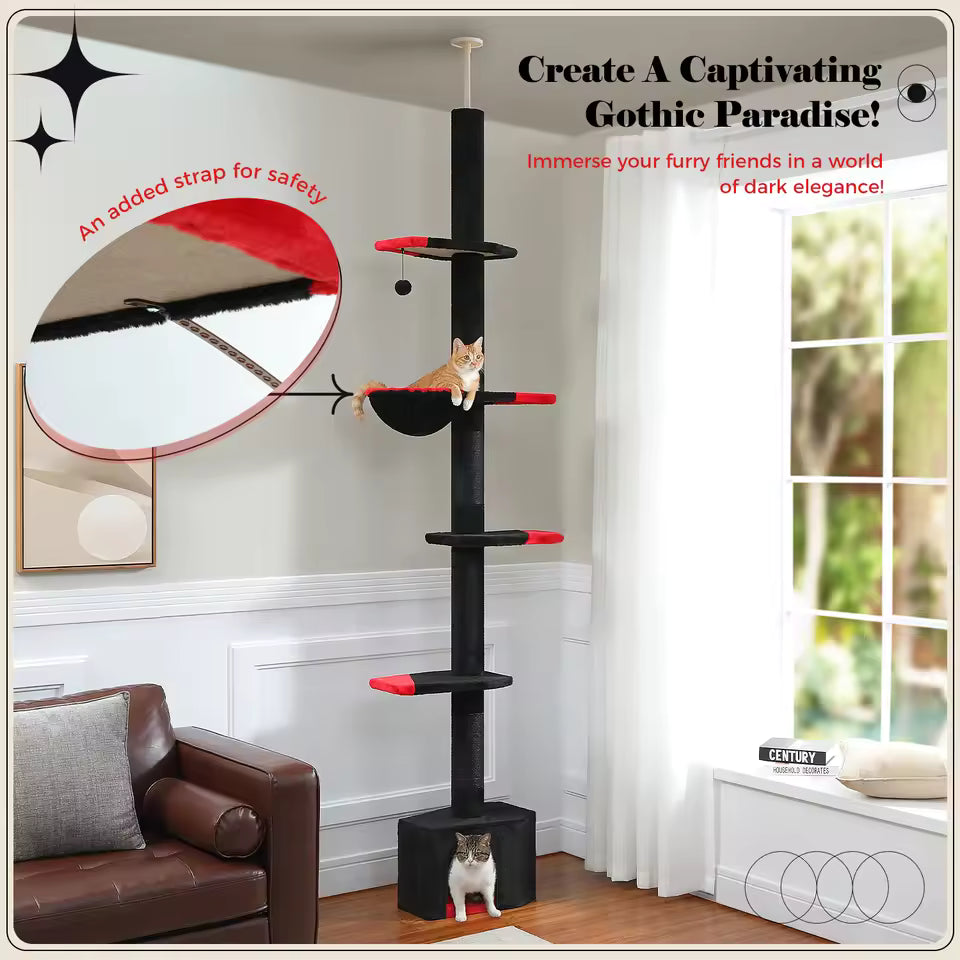
The 150cm multifunctional modern minimalist-style cat tree is a well-suited option for households wanting a contemporary-looking structure with genuine height and multiple resting levels. For something more substantial, the 180cm luxury multi-level cat tree with condo, scratching post, and cat tower provides a broader range of vertical territory with an enclosed condo and several open platforms at different heights.
Our large cat tree collection (100-200cm) is a good starting point for cat owners who want to provide meaningful vertical territory and are looking for a durable, well-constructed structure that will be used consistently.
For households where floor space is limited, wall-mounted climbing options offer an alternative route to vertical territory without requiring floor space. The wall-mounted cat furniture collection at Cat Tree Haven includes shelves, hammocks, and platforms that can be arranged in custom climbing routes along a wall.
The Simple Version
Cats love high places because height is genuinely useful to them. It provides safety, observation, social positioning, and secure rest. These aren't learned preferences - they're instincts shaped by thousands of years of evolutionary pressure that remains fully active in the domestic cat sitting on your kitchen counter right now.
Meeting this need doesn't require a complicated setup. A well-positioned cat tree with a good view gives most cats what they're looking for. The difference it makes to their behaviour and their settled contentment in an indoor environment is typically noticeable within the first few weeks.
At Cat Tree Haven, our range is built with this in mind - structures that give cats real vertical territory in a form that also works for the humans sharing the space.
Have a Question About What Your Cat Needs?
If you're not sure which type of cat tree or climbing structure suits your cat's specific behaviour and your home layout, our team is happy to help. We can point you toward options that are likely to be used and appreciated rather than ignored.
Get in touch with the Cat Tree Haven team and we'll help you find the right fit.
Frequently Asked Questions
Why do cats always want to be at the highest point in the room?
The drive to seek height is instinctive in cats and rooted in their evolutionary history as both predators and prey. Elevated positions provide an unobstructed view of the environment, making it easier to detect threats and monitor the surroundings while minimising personal vulnerability. This instinct remains fully active in domestic cats regardless of how safe their actual environment is.
Is it normal for cats to sleep in high places?
Yes, this is entirely normal behaviour. Resting at height reduces a cat's vulnerability during sleep by removing them from ground-level disturbance and providing a clear sightline of the surrounding space. Even in a completely safe indoor environment, the instinct to rest at elevation persists because it's hardwired into cat behaviour rather than being a learned response to actual threats.
Do all cats like to climb, or is it breed-specific?
Most cats have a strong inclination to seek height, though there is some variation between individuals and breeds. More active, athletic breeds such as Abyssinians, Bengals, and Maine Coons tend to be particularly enthusiastic climbers. Calmer breeds such as Ragdolls and Persians may show less interest in high-energy climbing but still typically prefer elevated resting spots when available. Individual temperament also plays a significant role.
Why does my cat climb to high places when stressed?
Seeking height during stress is a coping mechanism. An elevated position gives a stressed or anxious cat a sense of security and control over their environment - they can observe what's causing the stress from a safe distance rather than being in the middle of it. If a cat consistently retreats to the highest point in the room during stressful events, providing a dedicated elevated space like a cat tree can give them a more appropriate and stable retreat.
Can a lack of climbing opportunities affect my cat's behaviour?
Yes, it can. Indoor cats who have no access to elevated positions may show signs of stress-related behaviour, including excessive scratching, increased hiding, heightened reactivity, and in multi-cat households, increased conflict with other cats. These behaviours are not always connected to vertical territory, but providing appropriate climbing options is one of the more reliably effective environmental adjustments for indoor cats showing generalised signs of stress.
Why does my cat prefer the top of the wardrobe over the cat tree I bought?
If a cat is choosing the wardrobe over a cat tree, the most common reasons are that the wardrobe is taller, positioned near a window, in a more socially central area of the home, or simply reached first through habit. Cat trees tend to get used more consistently when they're placed near windows, in rooms where the family spends time, and when the cat has been encouraged toward them early. Placement and positioning make a significant difference to whether a cat tree gets used.
Do cats grow out of the need to climb as they get older?
Senior cats typically become less agile and may reduce how frequently and how high they climb, but the instinctive preference for elevated positions generally remains. Older cats often benefit from cat trees with lower platforms and gentler step spacing that allow them to reach elevated resting spots without requiring large jumps. The need doesn't disappear - it often just needs to be accommodated differently as a cat's mobility changes with age.