
Key Takeaways
- Multi-cat households need cat trees with multiple perch levels, condos, and scratching posts to reduce competition and territorial tension
- Height variety is critical - cats establish hierarchy through vertical positioning, so more levels means fewer conflicts
- Larger, sturdier bases and heavier construction are essential when multiple cats will be using the same structure
- Separate resting spots and enclosed condos give each cat a sense of their own territory within a shared piece of furniture
- Cat Tree Haven stocks a wide range of large, multi-level cat trees suited to homes with two or more cats, with free shipping across Australia
Having more than one cat is one of the more rewarding things you can do as a pet owner. It's also, if you've lived it, one of the more complicated. Cats are territorial by nature. They share space on their own terms, establish hierarchies that shift constantly, and have very clear opinions about who gets to sit where. Add a second or third cat into a home and suddenly the furniture arrangements that worked before are a point of negotiation.
A good cat tree changes the dynamic considerably. It creates structured vertical territory - defined climbing routes, separate perches, enclosed resting spots - that lets multiple cats coexist more easily without needing to compete for the same chair or windowsill. But not all cat trees are built for this. A tree designed for a single cat may be too small, too light, or simply too short to give a multi-cat household what it actually needs.
This guide covers what to look for and which types of cat trees are worth considering when you're buying for more than one cat.
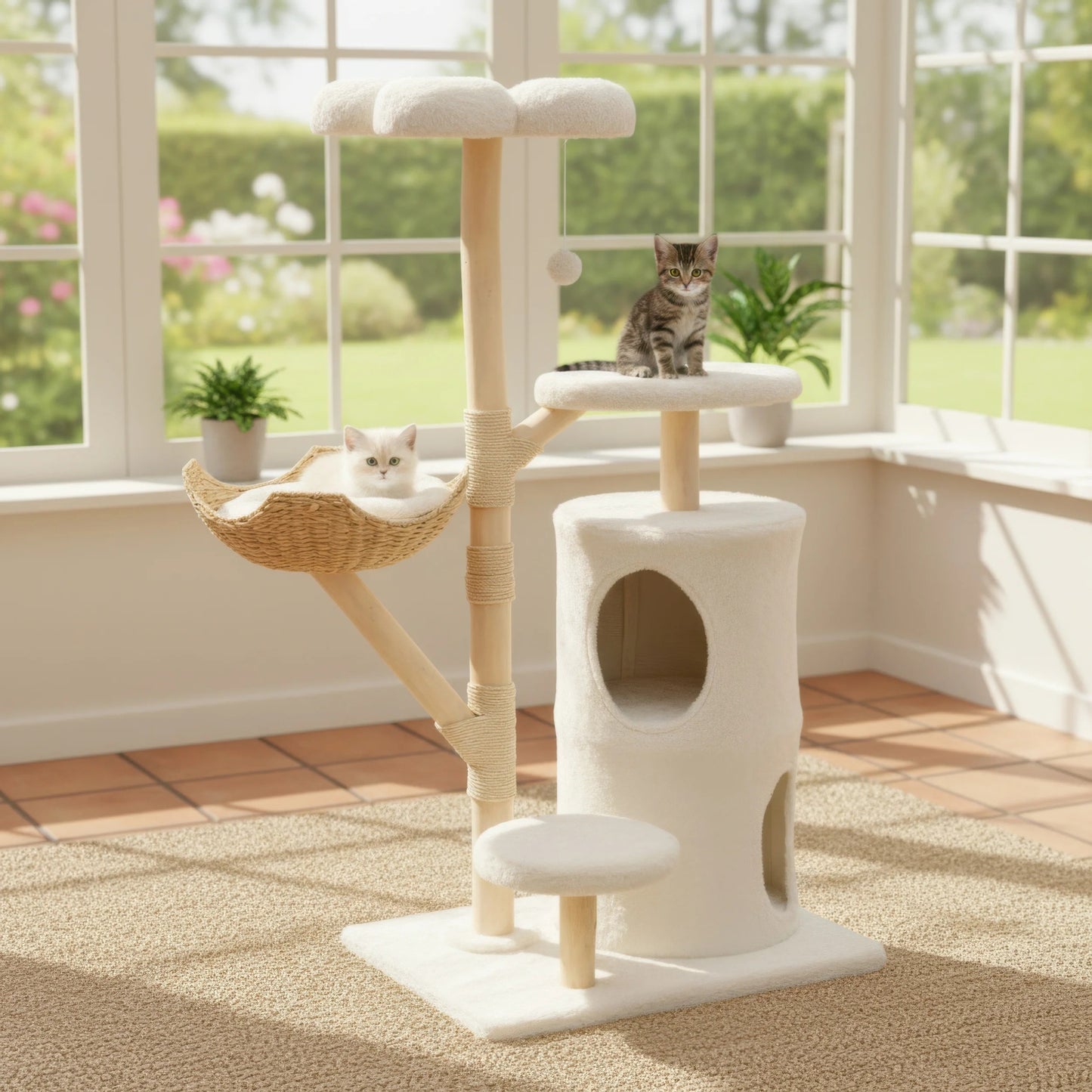
Why Standard Cat Trees Often Fall Short in Multi-Cat Homes
Most cat trees on the market are designed with a single cat in mind. They work well in that context - one cat, one perch, one scratching post. The moment you introduce a second cat, the dynamics change. Two cats on a single-perch tree means one cat gets the perch and the other has to negotiate for it. Over time, this kind of friction contributes to stress, territorial behaviour, and the kind of low-level conflict that makes a household tense.
The issues tend to cluster around a few areas:
Too few levels. Cats use height to establish social positioning. A dominant cat will typically claim the highest spot. If there's only one high spot available, the subordinate cat has nowhere to retreat that feels safe. A tree with multiple distinct levels at varying heights gives each cat a meaningful place to occupy without direct confrontation.
Too little stability. A tree built for one cat that's being climbed by two simultaneously will wobble, tip, or shake - which is both a safety risk and a reason for cats to avoid it. Multi-cat households need heavier construction, wider bases, and robust fixings.
Not enough enclosed spaces. Open perches are great for confident cats who like to observe from above. But cats who are lower in the household hierarchy - or simply more anxious - often prefer enclosed condos where they can retreat and feel protected. A tree with at least one or two enclosed spaces gives those cats somewhere to go.
Insufficient scratching surface. One sisal post between two cats is rarely enough. Multiple posts, ideally on different levels, reduces competition and makes it more likely that all cats will use the tree consistently.
If you want to understand more about the behavioural side of this, our post on how cat trees can help reduce conflict in homes with multiple cats goes into more detail.
What to Look for in a Cat Tree for Multiple Cats
Height and Level Count
Taller trees with more distinct levels are consistently better for multi-cat households. A tree that reaches 150cm or above with three or more separate perching levels creates enough vertical territory for cats to spread out without crowding each other. The best options have a mix of open platforms at the top, mid-level perches, and lower-level condos or hammocks.
Load Capacity and Construction Quality
This is non-negotiable when multiple cats will be using the same structure. Look for trees made from solid wood or high-density particleboard rather than lightweight MDF, and check that the base is wide and weighted enough to handle the combined movement of more than one cat at once. A tree that rocks when a single cat jumps off the top is not suitable for two.
Multiple Sleeping Spots
Each cat in a household needs a spot they can call their own, even temporarily. A tree with only one sleeping platform creates competition by design. Look for at least two to three distinct resting areas - a combination of open perches, hammocks, and enclosed condos is ideal, as it caters to different preferences within the same household.
Scratching Post Coverage
Multiple sisal-wrapped posts at different heights - not just one at the base - give multiple cats the ability to scratch without competition. In practice, cats will often scratch in the presence of other cats as a form of territorial marking, so having posts distributed throughout the tree is more effective than a single post at the bottom.
Recommended Styles for Multi-Cat Households
Large Multi-Level Towers (150-200cm)
This is the most practical category for most multi-cat households. A tree in the 150-200cm range typically offers enough height, enough separate levels, and enough structural mass to handle two or three cats comfortably. These trees are the workhorses of the cat furniture world - not always the most design-forward, but genuinely functional in a way that matters for multi-cat dynamics.
The 160cm tall multi-level cat tree with condo, hammock, and scratching posts is a solid option in this range. It combines a large enclosed condo, an open hammock, multiple perches at different heights, and several sisal posts - covering the main requirements for a shared structure without being overly large.
For households where space allows something more substantial, the 206cm extra-large cat tree with multiple condos, tunnel, hammock, and sisal posts provides generous vertical territory, two separate condos, and a tunnel - enough distinct zones to accommodate three or more cats without significant competition.
Our large cat tree collection (100cm-200cm) is a good place to browse if you know you need something substantial but aren't sure exactly which height range works for your space.
Floor-to-Ceiling and Extra-Large Trees
For households with three or more cats, or for cats who are particularly active climbers, floor-to-ceiling options and extra-large trees offer the greatest vertical territory. These are genuinely impressive structures - they use your full ceiling height, feel very stable due to their ceiling pressure mounting, and give multiple cats the ability to spread across different levels simultaneously.
The extra-large cat tree collection (200cm and above) includes adjustable floor-to-ceiling towers and large multi-level structures that work well when you have multiple active cats sharing the same space.
Separate Supplementary Pieces
One approach that works particularly well in multi-cat households is using a large primary cat tree combined with one or two supplementary pieces - a wall-mounted shelf, a separate scratching post, or a standalone perch. This effectively creates multiple territory zones throughout the home rather than concentrating everything in one spot.
This matters because cats in multi-cat households benefit from having options in different rooms. A subordinate cat who feels crowded out of the main cat tree can retreat to a wall shelf in another room. This kind of spatial distribution reduces tension more effectively than any single piece of furniture can on its own.
Placement Strategies for Multi-Cat Households
Where you put the cat tree matters as much as which tree you choose.
Near a window, if possible. Window access is highly valued by most cats, and it naturally draws them toward the tree. In a multi-cat household, a window-facing tree becomes an attractive shared resource rather than an afterthought.
Not in a dead end. Cats who feel cornered - particularly lower-ranking cats who may be chased by others - need an escape route. A tree positioned where a cat can approach and leave from multiple directions reduces the risk of one cat trapping another.
Consider multiple zones. If you have two or more cats who don't always get along, having cat furniture in more than one room - even if the main tree is in the living area - gives each cat somewhere to withdraw that feels safe and separate.
Stability over aesthetics. In a multi-cat home, a tree will get more use and more impact than in a single-cat home. Prioritise a position where the tree can sit flat, where the base has full contact with the floor, and where it isn't at risk of being pushed into furniture or walls by an enthusiastic jump.
We cover placement in more depth in our post on the best places to put a cat tree for consistent daily use.
Maintenance Considerations for Shared Cat Trees
A tree used by multiple cats will wear faster than one used by a single cat. Hair builds up more quickly, sisal posts get used harder, and fabric perches need more frequent cleaning. Building a basic maintenance routine into your schedule from the start extends the life of the tree and keeps it hygienic for all the cats using it.
Vacuuming perches and platforms weekly is a reasonable starting point. Sisal posts don't typically need replacing as frequently as people expect - cats often prefer slightly used sisal to new - but if a post becomes truly shredded and structurally compromised, replacement post wraps are available for many models. Our cat tree care and maintenance guide has practical advice on keeping shared furniture in good condition over time.
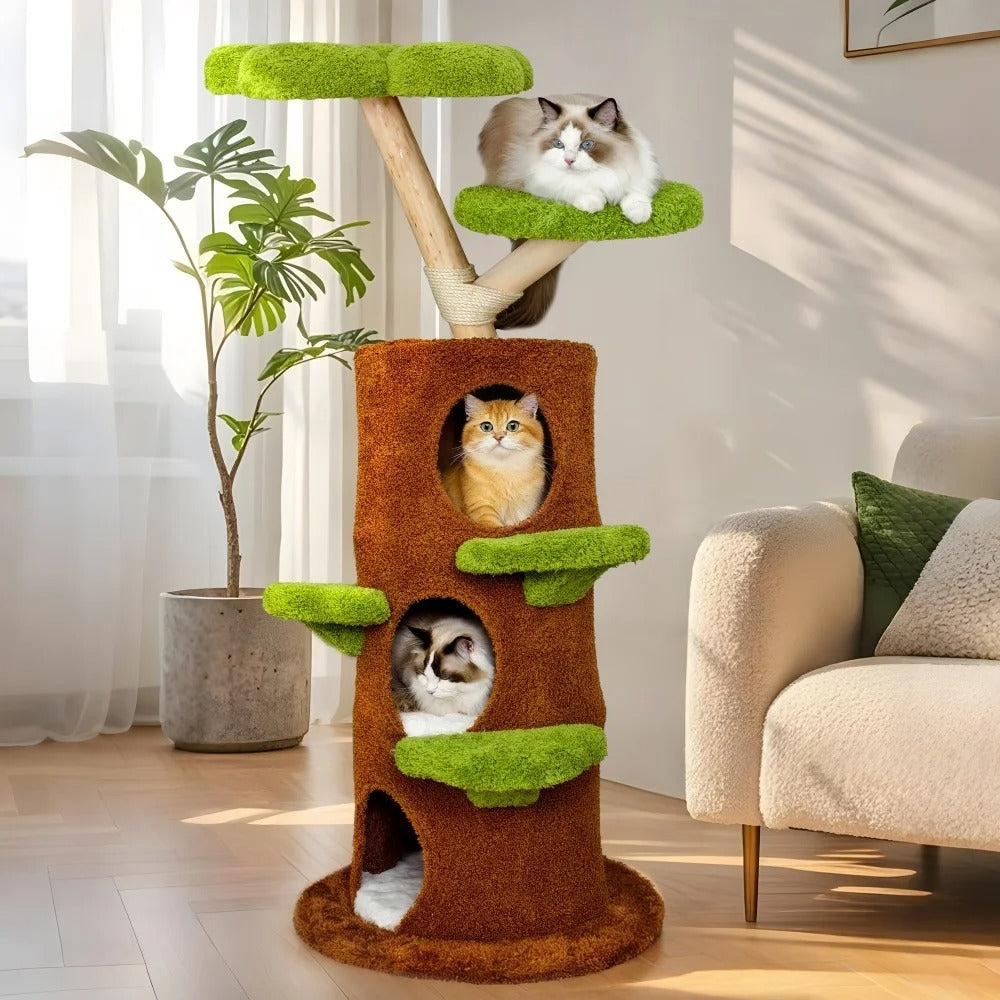
Finding the Right Tree for Your Household
There's no single right answer for every multi-cat home. The right tree depends on how many cats you have, how they interact with each other, how much space you have, and your budget. What we'd suggest is starting with the number of cats and working out the minimum number of perching levels and enclosed spaces you need from there - roughly one distinct sleeping spot per cat, plus one or two extras.
At Cat Tree Haven, we stock a range that runs from compact options for smaller homes through to large multi-level towers and floor-to-ceiling structures. Every order comes with free shipping across Australia, and we're happy to help if you're not sure which option suits your household best.
Need Help Choosing?
If you have a specific question about which tree works for your cats, our team is easy to reach. Whether you're deciding between two options or starting from scratch, we're happy to point you in the right direction.
Reach out to the Cat Tree Haven team and we'll help you find something that works for your household - and your cats.
Frequently Asked Questions
How many levels should a cat tree have for two cats?
For two cats, a tree with at least three distinct levels is a practical minimum. This gives each cat a meaningful perching option without forcing them to share a single platform. A mix of open perches and at least one enclosed condo is ideal, as different cats tend to prefer different types of resting spots.
Can two cats share one cat tree?
Yes, cats can and do share cat trees, particularly when the tree has multiple levels, separate condos, and several scratching posts. The key is providing enough distinct zones that neither cat feels forced to compete for the same space. Conflict is much less likely when each cat can claim a separate level or enclosure.
What size cat tree is best for a multi-cat household?
Taller is generally better for multi-cat households. A tree in the 150-200cm range with multiple platforms, at least one enclosed condo, and several sisal posts covers the needs of two to three cats reasonably well. For larger households or more active cats, extra-large and floor-to-ceiling options provide more vertical territory.
How do I stop cats from fighting over the cat tree?
The most effective approach is ensuring the tree has enough distinct spots for each cat - separate perches, individual condos, and multiple scratching posts. Positioning the tree near a window adds natural enrichment value, which tends to make cats more focused on the view than on each other. Supplementary pieces in other areas of the home also help by distributing territory across more space.
Do I need more than one cat tree for multiple cats?
Not necessarily, but it depends on how many cats you have and how they interact. Two cats with a relaxed relationship can often share a single large tree without difficulty. Three or more cats, or cats with a tense relationship, tend to do better with a main tree plus one or two supplementary pieces spread across different rooms.
What materials are most durable for a shared cat tree?
Solid wood frames and dense particleboard bases tend to hold up better under the repeated use of multiple cats than lighter materials. Sisal-wrapped posts are the most durable scratching surface available - they last longer than carpet and are better at satisfying cats' natural scratching instincts. Plush fabric perches are comfortable but will wear faster with multiple users, so look for removable or washable covers where possible.
How often should I clean a cat tree used by multiple cats?
Weekly vacuuming of all fabric surfaces is a reasonable baseline for a tree shared between two or more cats. Spot cleaning with a damp cloth as needed handles most surface marks. A more thorough clean every four to six weeks - including wiping down wood or board surfaces and checking sisal posts - keeps the tree hygienic and extends its usable life.