
If you live with more than one cat, you are probably familiar with at least some version of this: the stare-down across the kitchen floor, the sudden chase that erupts from nowhere, the cat that monopolises a particular armchair while the other skulks around the edges of the room. This kind of tension is extremely common in multi-cat households, and it tends to make owners feel like something has gone wrong with their cats' relationship.
In most cases, though, the problem is not the relationship. It is the environment. Specifically, it is the absence of enough usable territory for each cat to feel genuinely secure.
This is where cat trees become relevant - not as a toy or an accessory, but as an environmental intervention that addresses one of the most consistent causes of inter-cat tension. At Cat Tree Haven, we regularly speak with Australian cat owners who are dealing with household friction between their cats. This guide explains the mechanics of why cat trees help, what the research says, and what to look for in a tree designed for a multi-cat home.
Understanding Where Cat Aggression Usually Comes From
Cats are territorial by nature, and territory for a cat is not just horizontal floor space. It is a three-dimensional range that includes height, vertical vantage points, and defined zones for different activities: sleeping, watching, scratching, eating, and retreating.
In the wild, cats manage territorial tension partly through spatial separation. When one cat wants to avoid conflict with another, it moves to a different zone - a different elevation, a different area, a different direction. Conflict is kept at a manageable level because the environment offers enough options for separation without confrontation.
Indoor environments, particularly smaller apartments and modern Australian homes, often compress all of this available territory into a limited two-dimensional floor plan. When two or more cats are sharing a space that does not offer enough distinct zones, every resource - the preferred perch, the sunny spot on the window ledge, the comfortable sleeping place - becomes a point of competition. Competition leads to stress. Stress leads to tension. And tension, when it builds without release, leads to outright aggression.
The key insight from feline behavioural research is that this kind of aggression is a space design problem more than it is a cat personality problem. And space design problems, unlike personality incompatibilities, can be addressed with targeted environmental changes.
What the Research Says About Vertical Space and Cat Conflict
A study of cats living in a shared research facility found that adding shelving units to their living space led to a significant reduction in anti-social and agonistic behaviour between the cats. This finding is consistent with what cat behavioural specialists have observed in practice: providing more usable vertical territory reduces the competition-based tension that drives inter-cat conflict.
The mechanism is straightforward. When a cat can move to a higher level and observe the room from above, it does not need to compete with the cat at ground level for the same space. The two cats are effectively in different zones. The dominant cat's preference for the highest perch is accommodated without displacing the other cat from the space entirely. Both cats retain access to the shared environment; they simply occupy different parts of it simultaneously.
Research from Applied Animal Behaviour Science has similarly found that cats in multi-pet households regularly chose elevated resting spots as a way to avoid interactions with other animals and reduce stress. Height is not just a preference for cats - it is an active stress-management mechanism. Taking that option away from an indoor cat increases the likelihood that it will manage territorial tension through confrontation at ground level instead.
Dr Conrad, a veterinary professional consulted in coverage by Rover.com, put it plainly: encouraging appropriate play and providing safe spaces reduces aggression between cats - and toward their humans. The safe spaces referred to are not hiding spots at floor level. They are elevated zones from which a cat can observe without being crowded.
Why the Design of the Cat Tree Matters
Not every cat tree is equally useful for reducing inter-cat tension. The design of the structure determines how effectively it creates distinct, separately usable zones rather than simply adding a single point of competition at height.
A single top perch creates a single competition point. If a cat tree has one desirable position at the top and several lower, less appealing platforms below, the dominant cat will claim the top and the lower-ranking cats may be effectively excluded from the structure. This does not expand usable territory in any meaningful sense - it just relocates the point of conflict from the floor to the top of the tree.
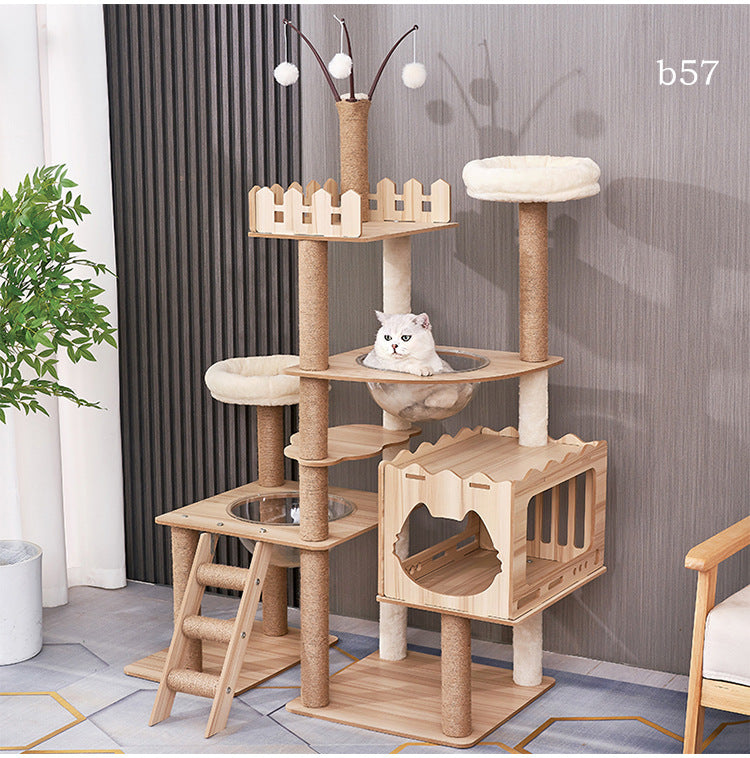
Multiple distinct levels at genuinely different heights allow different cats to occupy the structure simultaneously without being in direct proximity. A cat on the top perch, a cat in the mid-level hammock, and a cat in the lower condo are each in their own zone, with enough vertical and spatial separation to avoid the face-to-face proximity that triggers tension. Each has a position they can claim as their own.
Wide platforms matter. A narrow perch that fits one cat is a contested resource. A wide platform where two cats could, in principle, rest without touching each other is a shared resource. Even in households where the cats do not choose to share, the width signals spaciousness rather than scarcity, which reduces the drive to exclude.
Enclosed condos provide a retreat option. Cats that feel threatened or overwhelmed sometimes need to disappear entirely rather than just move to a higher elevation. A tree with an enclosed condo gives a lower-ranking cat a place to go that is genuinely private - where direct visual contact with the other cat is not possible. This is a meaningful de-escalation option that open-platform trees do not provide.
Specific Products Worth Considering
For multi-cat households where inter-cat tension is a real concern, here are some options from our range at Cat Tree Haven that are designed with this specifically in mind.
The 180cm luxury multi-level cat tree with condos, hammock, and scratching posts is one of our most suitable options for multiple cats living together. It accommodates up to four to six small and medium cats simultaneously, with two condos at different heights, two perches, a hammock, and six scratching posts distributed across the structure. Each element gives a different cat a reason to occupy a different zone, rather than all cats competing for a single desirable spot.
For households with larger or more active cats where the concern is both inter-cat tension and structural robustness, the 112cm grand multi-level cat tree with condo and scratching posts provides a more compact but solidly built option with multiple resting zones. The grand multi-level design distributes activity across the structure rather than concentrating it at the top.
Our large cat tree collection from 100cm to 200cm is the most practical starting point for multi-cat households, as the height range in this collection naturally provides the multiple distinct levels that make a meaningful territorial difference. Most of the trees in this range have been selected with durability and multi-cat use in mind.
For households with three or more cats or particularly active cats, our extra-large cat tree collection over 200cm includes floor-to-ceiling towers with platform distributions across a wider vertical range, giving cats more genuinely distinct zones at greater height separations.
How Many Cat Trees Does a Multi-Cat Household Need?
A useful rough guideline used by feline environment specialists is one premium spot per cat, plus one additional spot. In a three-cat household, this suggests four distinct desirable positions across the cat furniture in the home. These do not all need to be on a single tree, and in larger households it is often more effective to distribute furniture across multiple rooms rather than concentrating all of it in one location.
Distributing cat furniture across different rooms also reduces the likelihood that a single dominant cat can guard all resources simultaneously. A dominant cat can monopolise one tree. It cannot simultaneously monopolise a tree in the living room and a tree in the bedroom. Geographic separation of resources is itself a conflict-reduction strategy.
The same principle applies to all feline resources: food stations, water bowls, litter trays, and sleeping spots should be available in enough quantity and spread across enough locations that no single cat can position itself as a gatekeeper to all of them. Cat trees are one part of this broader environmental strategy, not a standalone solution.
When Cat Trees Help and When They Are Not Enough
It is worth being clear that cat trees are an effective environmental intervention for tension rooted in resource competition and territorial pressure, but they are not a solution for all forms of inter-cat aggression. Some cats, particularly those introduced to each other as adults after strongly established territorial patterns, may have conflict that goes beyond what environmental enrichment alone can address. In these cases, a consultation with a feline behaviour specialist or a vet experienced in feline behaviour is advisable alongside any environmental changes.
Signs that the situation may need professional input alongside environmental modification include: sustained, escalating aggression rather than occasional tension; one cat actively preventing another from accessing food, water, or the litter tray over an extended period; or physical injury resulting from conflict.
For most multi-cat households where the tension is typical territorial friction rather than severe or escalating aggression, improving vertical space is one of the most reliable first steps. Our post on why vertical space reduces territorial conflict in multi-cat homes covers the underlying behavioural mechanics in detail, and is worth reading alongside this article for a fuller picture.
Our post on how cat trees help reduce fighting and improve harmony between cats goes further into practical management strategies for households where inter-cat tension is an ongoing concern.
And for cats in shared homes where the tension has spilled over into anxious or withdrawn behaviour rather than direct aggression, our post on how cat furniture supports cats with anxiety in multi-cat environments provides a useful companion perspective.

The Short Answer
Yes, cat trees can meaningfully reduce aggression between cats - but the effect depends on choosing the right kind of tree and placing it as part of a broader environmental strategy. A single-perch tree adds one desirable spot that cats will compete for. A well-designed multi-level tree with condos, hammocks, and wide platforms adds several distinct zones, effectively expanding the home's usable territory in three dimensions and reducing the resource pressure that drives inter-cat conflict.
If you are managing tension between cats in your home and would like help identifying the right cat tree setup for your specific situation, Cat Tree Haven is happy to talk it through.
Get in touch with our team here and we will help you find an option that works for your cats and your space.
Frequently Asked Questions
Can a cat tree really reduce fighting between cats?
Yes, in many cases. Inter-cat conflict in shared homes is frequently rooted in competition for limited resources and territory, particularly elevated positions. Adding a well-designed multi-level cat tree expands the available vertical territory without increasing floor space, allowing cats to occupy separate zones simultaneously and reducing direct competition. Research into cats in shared facilities found that adding vertical shelving reduced agonistic behaviour significantly.
How many platforms does a cat tree need for two cats?
As a general guideline, one distinct platform per cat plus at least one additional spot is a useful starting point. For two cats, a tree with at least three distinct levels - ideally including an enclosed condo, a mid-level hammock or platform, and a top perch - provides enough spatial options for both cats to find a position without displacing each other.
Does the height of the cat tree affect how well it reduces conflict?
Height matters because it determines how much genuine vertical separation exists between levels. A tree where all platforms are within 20cm of each other does not provide meaningful spatial separation. A tree where the top perch, mid-level hammock, and lower condo are separated by 40 to 60cm or more gives cats genuinely distinct zones.
Will one cat tree be enough for a three-cat household?
For three cats, one tree with multiple levels may be sufficient if the tree has enough distinct zones and the cats are compatible enough to share the structure. In many three-cat homes, distributing cat furniture across two locations - one tree in the main living area and a smaller option in a secondary room - works better than concentrating everything in one spot, because it prevents a dominant cat from guarding all resources simultaneously.
Is cat aggression always a space problem?
Not always. Territorial tension rooted in resource competition is the most common cause of inter-cat friction, and this is a space design problem that environmental changes like cat trees can address. However, some inter-cat aggression has other causes, including redirected aggression, pain or illness in one cat, or deep incompatibility between animals introduced as adults. Where aggression is severe, escalating, or resulting in injury, a veterinary or feline behaviour consultation is advisable alongside environmental changes.
Where should I place a cat tree to best reduce inter-cat tension?
Near a window in a frequently used room is typically the most effective placement, as the window view provides a reason for cats to use the tree and the elevated position satisfies the territorial preference for height with external visual stimulation. Avoid positioning the tree in a narrow space where one cat can block access for another. Corner placement supports stability and gives cats a sense of backing while perched.
Do I need to buy a separate cat tree for each cat?
Not necessarily, though it depends on the number of cats and the size of the home. A single large multi-level tree can accommodate multiple cats if it has enough distinct zones. In larger households or homes where territorial tension is significant, distributing cat furniture across multiple rooms is generally more effective than one large structure in a single location.