
Key Takeaways
- Freestanding cat trees are easier to set up, more portable, and suitable for renters without any wall modification
- Wall-mounted cat furniture saves floor space and can be configured in custom climbing routes tailored to your specific room layout
- Wall-mounted options require drilling into wall studs or masonry and are generally a more permanent installation
- The right choice depends on your living situation, your cat's needs, your available floor and wall space, and your budget
- Cat Tree Haven stocks both freestanding cat trees and wall-mounted cat furniture, with free shipping across Australia
It's one of the more common questions we get from cat owners who are setting up a space for a new cat or refreshing an existing setup: should I get a freestanding tree or go with wall-mounted shelves? Both approaches give your cat vertical territory, scratching surfaces, and places to rest. But they work quite differently in practice, and the better choice for one household is often the wrong choice for another.
This guide works through both options clearly and honestly. We're not going to tell you one is better than the other in absolute terms, because the answer genuinely depends on factors specific to your home, your cat, and your living situation. What we will do is give you a clear picture of how each type performs across the things that actually matter when making this decision.
How Each Type Works
Before comparing them, it's worth being precise about what each option actually is.
A freestanding cat tree is a self-contained structure that stands independently using a weighted base. It can be placed anywhere in a room, doesn't attach to any fixed surface, and can be moved or repositioned without any tools or remediation work. These range from compact single-post scratching towers to large multi-level structures with condos, hammocks, and multiple platforms.
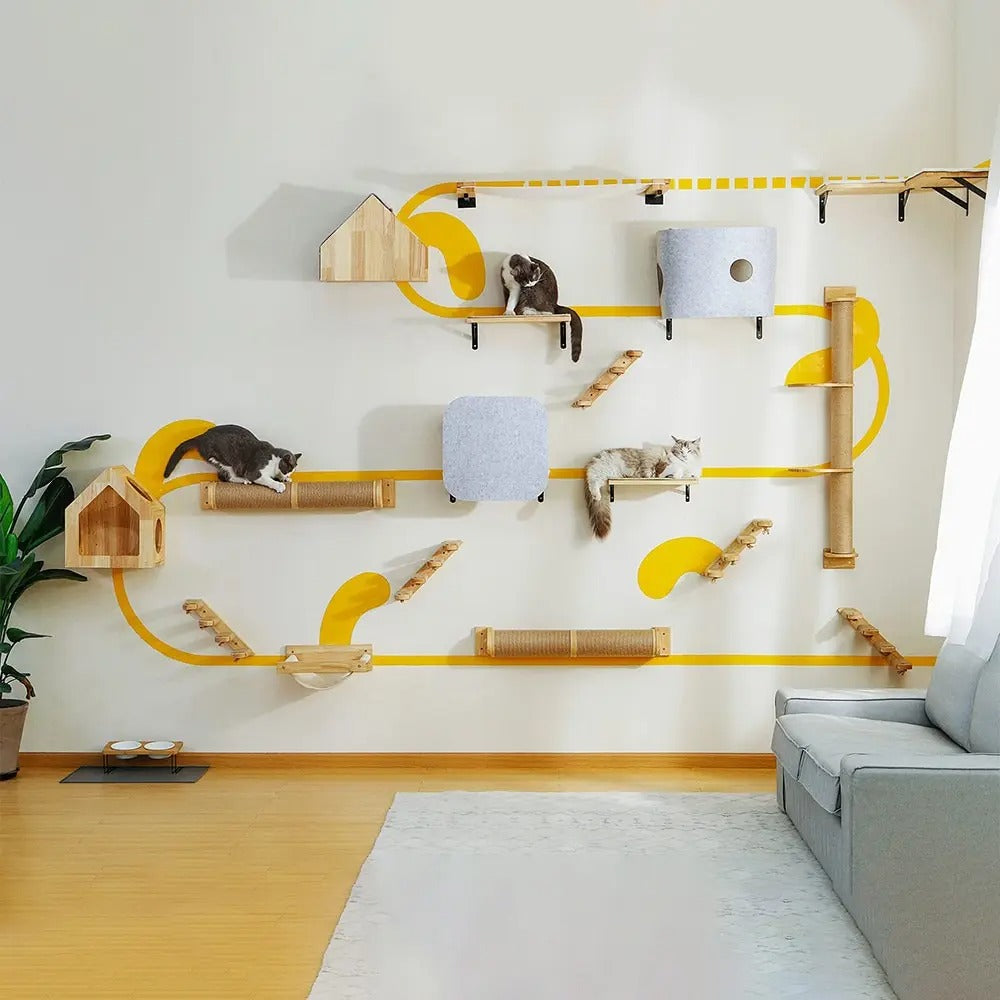
A wall-mounted cat setup consists of individual pieces - shelves, perches, hammocks, ladders, scratching posts - that are fixed directly to the wall using brackets and screws. They don't have a base or a central pole. Instead, they're arranged in a sequence that creates a climbing route along the wall, configured however the owner chooses. Each piece is mounted independently and anchored into wall studs or suitable masonry.
These are meaningfully different products with different installation requirements, different aesthetics, and different practical implications. Understanding that difference clearly is the starting point for making the right call.
Where Freestanding Cat Trees Have the Advantage
No Installation Required
The most straightforward advantage of a freestanding cat tree is that you simply place it and use it. There's no drilling, no locating wall studs, no concern about whether the wall material can hold the weight of a mounted bracket under load. For many cat owners, this is the decisive factor - particularly those who aren't comfortable with basic wall installation tasks or who don't have the tools readily available.
Assembly is typically required, but it involves connecting posts and platforms together rather than making any permanent modification to the room itself.
Portability and Flexibility
A freestanding tree can be moved. If you rearrange your furniture, change the room layout, or decide the tree works better near a different window, you can shift it without any lasting consequence. If you move house, the tree goes with you and can be set up in a new space without any adjustment beyond finding a suitable spot.
This flexibility is often underrated when people are shopping for cat furniture. Living arrangements change. Rooms get repurposed. A tree that was in the corner of the living room may work better in a bedroom a year later. With a freestanding tree, that's straightforward. With wall-mounted pieces, relocating means removing fixings and patching walls.
Suitable for Renters
Most rental agreements in Australia restrict tenants from making holes in walls, or at minimum require any wall damage to be remediated before the end of the tenancy. Freestanding cat trees are fully compatible with rental living - they leave no marks on walls or floors and can be removed completely when you vacate.
This makes them the default practical choice for the large proportion of Australian cat owners who rent rather than own their homes.
All-in-One Functionality
A good freestanding cat tree integrates multiple features - scratching posts, perches at different heights, enclosed condos, hammocks, and dangling toys - into a single coherent structure. Everything is designed to work together and positioned relative to each other in a way that makes sense for a cat to navigate. There's no need to plan a layout or think about how individual pieces connect, because that work has already been done in the design of the tree.
Where Wall-Mounted Cat Furniture Has the Advantage
Floor Space Preservation
The single most compelling reason to choose wall-mounted cat furniture is that it uses wall space rather than floor space. In an apartment or smaller home where every square metre of floor area matters, a wall-mounted climbing route can give a cat substantial vertical territory without occupying any of the space you need for furniture, movement, or everyday living.
This is particularly relevant in Australian cities where apartment living is common and living spaces tend to be compact. A well-designed wall-mounted setup can transform an otherwise empty wall into a fully functional cat environment without reducing the usable area of the room at all.
Fully Customisable Layout
Wall-mounted furniture gives you complete control over the climbing route. You decide where each shelf sits, how far apart the steps are, whether there's a hammock mid-route or at the top, whether the path goes straight up or diagonally across the wall. This level of customisation isn't possible with a freestanding tree, which arrives in a fixed configuration.
For cat owners who want to create a genuinely unique climbing environment - or who have a specific room layout that a standard tree doesn't suit - wall-mounted pieces offer creative possibilities that freestanding options don't.
Aesthetic Integration
Wall-mounted cat furniture tends to integrate more naturally into contemporary interior design. Clean-lined shelves and platforms in natural wood tones look like considered design elements rather than pieces of pet equipment. In a home where interior aesthetics matter, a wall-mounted climbing route can feel like part of the room rather than an addition to it.
This is one reason wall-mounted options have grown in popularity alongside the broader trend toward modern minimalist cat furniture that doesn't announce itself as pet product from across the room.
Stability at Height
Individual wall-mounted shelves, properly anchored into wall studs or masonry, are fixed structures. They don't move, rock, or wobble when a cat lands on them. For high platforms specifically, this is an advantage - a cat perching at 2m height on a wall shelf secured directly to the wall is on a more inherently stable surface than one at the same height on a freestanding tree, where stability depends on the base and construction quality of the whole structure.
The Real Limitations of Each Option
Freestanding Trees: What to Watch For
The main practical limitation of freestanding cat trees is stability relative to height. A well-made tree with a wide, heavy base and quality construction is stable in use. But taller, cheaper trees - particularly those with narrow bases and lightweight materials - can wobble under an active cat's movement. For heavy cats or multi-cat households, construction quality matters more than it does for a small cat used gently.
Freestanding trees also require floor space. Even a compact model has a footprint, and larger multi-level trees can occupy a meaningful portion of a room. In very small spaces, this is a genuine constraint.
For guidance on avoiding poor-quality construction, our post on how to identify a low-quality cat tree before purchasing walks through the warning signs that are worth checking before you commit to a purchase.
Wall-Mounted Furniture: What to Watch For
The installation requirement is the most significant barrier. Wall-mounted cat furniture needs to be fixed securely into wall studs or appropriate masonry - not just into plasterboard alone, which won't hold the dynamic load of a cat landing on a bracket-mounted shelf. Getting this right requires either confidence with basic construction tasks or willingness to have someone else install it.
For renters, it requires landlord permission and either acceptance that the holes will need patching or confidence that small, well-patched fixings will satisfy the end-of-tenancy inspection. This is a legitimate consideration that stops wall-mounted furniture from being a practical option for many Australian renters.
Wall-mounted setups also tend to require more planning upfront. Choosing where each piece goes, spacing them appropriately for your cat's jumping ability, and ensuring the overall route makes sense for a cat to navigate is more involved than placing a freestanding tree in a corner.
Our post on the benefits of wall-mounted cat setups for saving space in smaller Australian homes explores the wall-mounted option in more depth if you're seriously considering it.
What the Cat Tree Haven Range Offers in Both Categories
For freestanding options, Cat Tree Haven stocks a wide range from compact models suited to smaller spaces through to large multi-level structures with condos, hammocks, and multiple sisal posts. The 91cm modern solid wood cat tree with sisal scratching post, cosy beds, and toy ball is a well-constructed option for smaller spaces, while the 184cm multi-level luxury cat tower with condo, hammock, and scratching post is a substantial structure for households that want a comprehensive freestanding setup.
For wall-mounted furniture, the wall-mounted wooden cat bridge is a clean, contemporary option that provides an elevated walkway along the wall without taking up any floor space. It works well either as a standalone piece or as part of a broader wall-mounted climbing arrangement.
The full wall-mounted cat furniture collection includes shelves, hammocks, ladders, and platforms that can be combined in configurations to suit different room layouts and different cats.
For freestanding options across the full height range, the large cat tree collection (100-200cm) covers the most popular range for active adult cats and multi-cat households.
How to Decide: A Simple Framework
If you're still weighing up which direction to go, these questions tend to point toward the right answer fairly quickly:
Do you rent? If yes, a freestanding tree is almost certainly the more practical choice unless you have explicit landlord permission to make wall fixings and are confident patching them later.
Is floor space your primary constraint? If you're genuinely short on floor area but have good wall space available, wall-mounted furniture is worth the installation effort.
Do you move frequently? Freestanding trees are far easier to take with you. Wall-mounted setups require disassembly and wall remediation each time.
Do you want a custom climbing environment? If you have a specific room layout in mind and want to design the cat's climbing route to fit it, wall-mounted pieces offer that flexibility.
Is installation a barrier? If drilling into walls isn't something you're comfortable with or able to do, a freestanding tree removes that obstacle entirely.
For a broader look at how placement affects whether a cat actually uses their tree, our post on finding the best position for a cat tree in your home is worth reading alongside this guide.
Not Sure Which Direction to Go?
If you've read through everything here and you're still not certain which option suits your home best, we're happy to help you work through it. The Cat Tree Haven team can answer questions about specific products, dimensions, installation requirements, or how a particular piece might work in your space.
Get in touch with the Cat Tree Haven team and we'll point you in the right direction.
Frequently Asked Questions
Is a freestanding cat tree or wall-mounted cat furniture better for a small apartment?
It depends on where your space constraint lies. If you're short on floor space but have open wall space, wall-mounted cat furniture can give your cat vertical territory without reducing your usable floor area. If floor space is less of an issue but you want something quick and easy to set up, a compact freestanding tree is simpler. Many small apartment owners combine both - a primary freestanding tree with one or two supplementary wall pieces.
Can I install wall-mounted cat furniture in a rental property?
Possibly, but it depends on your lease agreement and your landlord's position. Wall-mounted cat furniture requires drilling into walls, which most standard rental agreements restrict without permission. If you rent and cannot get permission for wall fixings, a freestanding cat tree is the more practical option. It leaves no marks and can be removed completely when you vacate.
Are wall-mounted cat shelves safe?
Wall-mounted cat shelves are safe when correctly installed into wall studs or appropriate masonry using fixings rated for the load. The key risk is inadequate installation - shelves fixed only into plasterboard without stud backing may not hold the dynamic load of a cat landing on them. If you're not confident about locating studs or assessing your wall type, it's worth getting professional advice before installing.
How stable are freestanding cat trees compared to wall-mounted options?
A well-made freestanding tree with a wide, heavy base is stable for most cats in typical use. Wall-mounted shelves, properly installed, are fixed structures that don't move at all when a cat lands on them. For very active cats, large breed cats, or multi-cat households with a lot of traffic on the tree, wall-mounted pieces have an inherent stability advantage at height. For most standard use cases, a quality freestanding tree is stable enough.
Can I combine freestanding and wall-mounted cat furniture?
Yes, and this is a practical approach for many households. A freestanding tree as the primary structure - with scratching posts, condos, and multiple perches - combined with one or two wall-mounted shelves or a wooden bridge elsewhere in the room gives cats more territory across different areas without requiring a full wall-mounted installation.
What tools do I need to install wall-mounted cat furniture?
Basic installation requires a drill, appropriate drill bits for your wall type, a spirit level, a stud finder if you're fixing into timber framing, and the fixings specified for the product you're installing. The specific requirements vary by product and wall material. Always follow the manufacturer's installation instructions and use fixings rated for the weight load involved.
Which type of cat furniture is better for multiple cats?
For multi-cat households, having enough territory across the home matters more than which type of furniture you choose. A large freestanding multi-level tree with multiple perches and condos can work well for two or three cats. Adding wall-mounted pieces in a separate area of the home creates additional territory zones, which helps reduce tension between cats who need space from each other. Using both types together is often the most effective approach in multi-cat homes.