
If you have ever brought home a kitten and a cat tree at the same time, you have probably witnessed what happens within the first hour or so. The box the tree came in gets investigated. The tree itself gets sniffed, pawed, climbed onto, scratched, and generally treated as a magnificent new discovery - all within the time it takes to make a cup of tea.
Then, a few years later, you buy a new tree for that same cat, now fully grown. You assemble it in the same spot. You step back. Your cat walks past it, looks at it with what can only be described as mild suspicion, and goes back to the couch.
This difference in response is not a coincidence, and it is not simply about individual cat personality. There is a well-understood developmental reason why kittens take to new environments and new furniture with such ease, and why adult cats - even perfectly confident, well-adjusted ones - tend to approach novelty with considerably more caution.
Understanding this makes a real difference to how you introduce a cat tree, what to expect from the process, and how to choose the right tree depending on where your cat is in their life. At Cat Tree Haven, we put together this guide to explain the science clearly and practically.
The Sensitive Period: Why Kittens Are Wired to Explore
The core explanation for why kittens adapt so much faster is a developmental window called the sensitive period for socialisation. In cats, this period runs roughly from 2 to 9 weeks of age, and it is the window during which a kitten's brain is most receptive to forming lasting associations with people, animals, environments, and objects.
During this period, the neurological architecture for fear responses is not yet fully operational. Fear is learned and refined over time, but in very young kittens, curiosity consistently outweighs caution. A kitten at 7 weeks approaches a new object - any new object - with exploratory energy rather than protective wariness, because their nervous system has not yet built up the layer of learned caution that develops as they grow.
Research published in Applied Animal Behaviour Science has found that kittens exposed to a variety of stimuli before 9 weeks of age were significantly less likely to exhibit fear-based responses in adulthood. The brain during this window is, in a sense, in a heightened state of learning - actively building associations between novelty and outcome. Positive experiences with new environments, textures, heights, and objects during this window tend to create lasting foundations of confidence and adaptability.
This is why kittens introduced to a cat tree during their first few weeks in a new home typically take to it very quickly. The tree is not encountered as a threatening foreign object - it is simply another interesting feature of an interesting world.
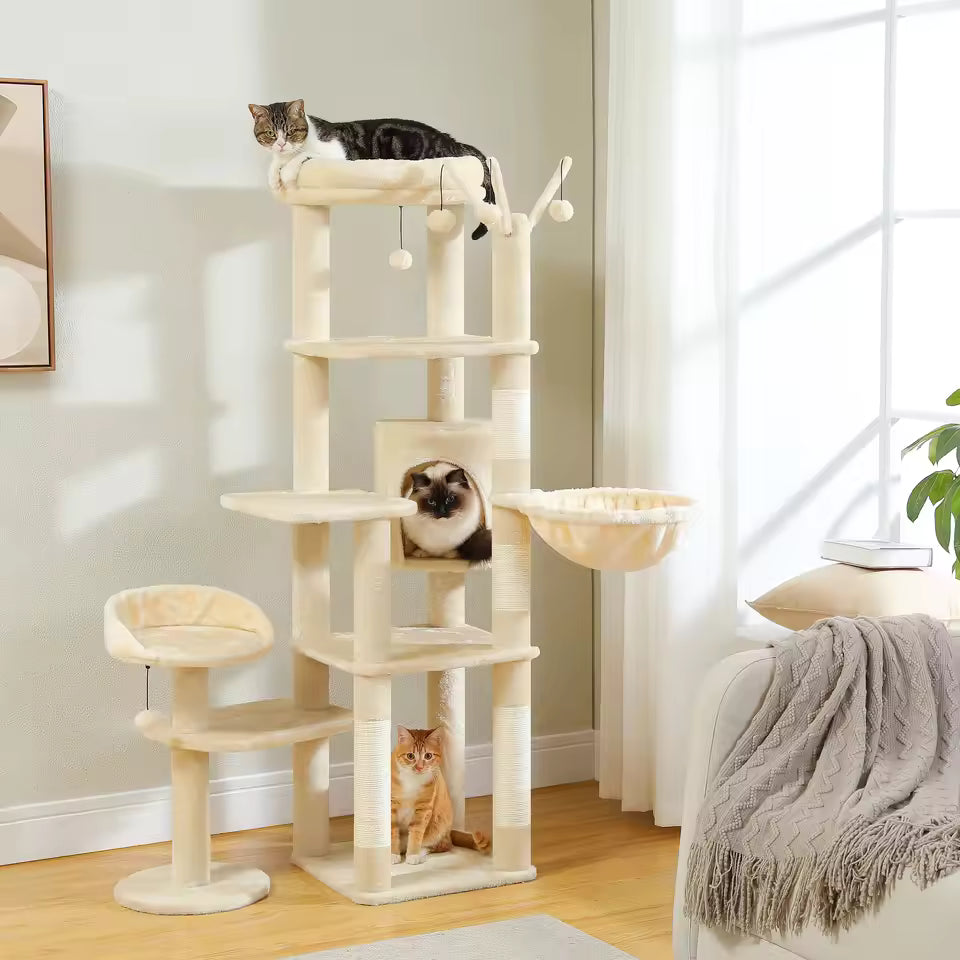
What Changes After the Sensitive Period
Once the sensitive period closes - which generally happens well before most kittens arrive in their new homes at 8 to 12 weeks - the neurological balance between curiosity and caution begins to shift. This is adaptive: adult cats that approached every novel thing in their environment with complete fearlessness would not survive long in the wild. The development of appropriate caution is a normal and healthy part of feline development.
By adulthood, cats have established patterns of what is safe, what is familiar, and what requires more careful assessment. A new cat tree placed in an established adult cat's environment is immediately flagged as unfamiliar. It smells different, looks different, and occupies space in a way the cat has not previously experienced. An adult cat's instinct is to assess this carefully before committing - and depending on temperament, that assessment can take anywhere from a few hours to several weeks.
This is not stubbornness or indifference. It is a fundamentally different behavioural default than the one kittens operate with. An adult cat is applying learned risk assessment to an unfamiliar object, and that process takes time.
An important piece of research from Karsh and Turner, published in The Domestic Cat, established that the quality of early experiences during the socialisation window directly shapes a cat's lifelong personality and adaptability. Cats who had rich, positive early experiences consistently showed greater confidence and adaptability with new environments throughout their lives. Cats who missed out on that early exposure tended toward more cautious patterns that were harder - though not impossible - to shift.
What This Means for Kitten Cat Tree Selection
Because kittens are in a heightened state of environmental learning when they arrive in a new home, the experiences they have with their first cat tree carry unusual weight. A positive experience - finding the tree stable, accessible, and rewarding to explore - creates associations that tend to persist into adulthood. A negative early experience - falling from a platform that was too high, being startled by a structure that wobbled, or finding that the gaps between levels were too large to navigate safely - can also persist, and may contribute to a cat that avoids their tree well into later life.
This makes the design of a kitten's first cat tree genuinely important.
Height and gap between platforms matter more for kittens than for adult cats. A kitten does not yet have the fully developed coordination, muscle strength, or spatial judgement of an adult. A tree with large gaps between levels or very high platforms requires leaps that a young kitten may misjudge. The result can be a fall or a stumble that the kitten associates with the tree. Structures with closely graduated platforms that the kitten can step between progressively are safer and tend to result in more confident early use.
Stability is non-negotiable. A tree that wobbles when a kitten first climbs it teaches that kitten that the structure is not safe, and that lesson may prove durable. A stable tree with a solid, wide base gives the kitten consistent confidence in the structure, which translates to consistent use.
Accessible features keep a kitten engaged. Dangling toys, sisal posts at lower heights where kittens can scratch without needing to stretch awkwardly, and enclosed condos that feel secure all make the tree more appealing for a small animal that is still building physical and spatial confidence.
Our compact cat tree range under 100cm includes several options that work well for kittens specifically because the height range is appropriate for a developing animal that is not yet ready for very tall structures, while still providing real enrichment through multiple levels, scratching posts, and interactive features.
The 73cm cat climbing frame with scratching post and platform is one such option - a compact, lower structure that provides genuine climbing and scratching opportunities without exposing a young kitten to heights that are beyond their developmental readiness. Similarly, the 68cm to 93.5cm cactus pet cat tree with ball scratcher posts offers height flexibility in a design that suits a kitten moving through different stages of physical development.
For further guidance on the safety and feature considerations specific to kitten cat trees, our detailed post on what to look for when selecting a first cat tree for a kitten covers the topic thoroughly.
Introducing a Cat Tree to an Adult Cat: What Works
If your cat is an adult and you are introducing a cat tree for the first time - or reintroducing one after an absence - the process simply needs to be longer and more gradual than it would be for a kitten. This is not a sign of a problematic cat; it reflects the normal behavioural reality of an adult animal encountering something new.
The most effective approach involves scent first. Before expecting your adult cat to use a tree, help it smell familiar. A worn item of your clothing placed on a perch, or a blanket the cat already uses transferred to the tree's platform, begins the process of association. The cat's own scent on the structure signals that this is territory they are comfortable claiming.
Placement matters considerably. An adult cat is more likely to engage with a new tree that is positioned near a window - with outdoor visual stimulation to provide a reason to climb - or in a room they already occupy regularly, than one placed in a secondary space they rarely use.
Play-based introduction is the most consistent technique for building positive association. Using a wand toy to draw an adult cat toward the base of the tree, then progressively up its levels during short play sessions, gradually rewrites the cat's association with the structure from "unfamiliar object" to "place where good things happen." Short sessions are more effective than long ones, and low-pressure is more effective than enthusiasm.
Treats placed at progressively higher levels are a useful parallel strategy for food-motivated cats. The logic is the same: build association through repeated small positive experiences rather than trying to overcome caution in a single intervention.
Our post on how to encourage a cat that is ignoring its cat tree to start using it covers the practical steps in more detail for owners who are working through this process with an adult cat.
Choosing the Right Tree When You Have Both a Kitten and an Adult Cat
Households with both a kitten and an adult cat face an interesting cat tree dynamic. The kitten will likely adopt the tree rapidly and energetically; the adult cat may take considerably longer and may feel displaced by the kitten's confident use of the structure.
In these cases, a tree with enough levels and spatial separation for both animals to occupy the structure at different heights - without being in direct competition - tends to work best. The adult cat's tendency to claim the highest available perch as a dominance position is well-documented, so ensuring the tree has a comfortable elevated perch that the adult can occupy without competition from the kitten reduces conflict and encourages use by both animals.
Our large cat tree collection from 100cm to 200cm includes multi-level structures with enough height and separation to accommodate this kind of shared use. The 137cm cat tree tower with two condos, three scratching posts, and dangling balls is specifically described as suited to both kittens and adult cats, with multiple zones that allow animals at different activity levels to find their own space within the same structure.
For a broader look at why multi-cat households benefit from thoughtful vertical space planning, our post on how vertical territory reduces conflict in multi-cat homes goes into the behavioural background in more depth.

The Practical Takeaway
The difference between a kitten that adopts a cat tree in an hour and an adult cat that takes three weeks is not a character difference - it is a developmental one. Kittens are neurologically primed for exactly this kind of rapid adaptation during the early months of their life. Adults are operating with established patterns that require more time and more deliberate positive reinforcement to shift.
Knowing this changes what you expect, and what you try. With kittens, the work is mostly in choosing the right tree for their physical stage. With adults, the work is in the introduction process itself - patient, low-pressure, and consistently positive.
If you are choosing a first cat tree for a kitten, or working through the introduction process with an adult cat that is taking its time, Cat Tree Haven is happy to help you think through the right approach.
Get in touch with our team here and we can point you toward the right option for your cat's age, size, and individual temperament.
Frequently Asked Questions
Why do kittens adapt to cat trees faster than adult cats?
Kittens have a biologically distinct sensitive period for socialisation and environmental learning between approximately 2 and 9 weeks of age. During this window, fear responses are not yet fully developed, and curiosity consistently outweighs caution. Kittens approach new objects and environments with exploratory energy rather than the learned caution that adult cats apply to unfamiliar situations.
At what age should I introduce a cat tree to a kitten?
As soon as your kitten arrives in their new home is a good time to make a cat tree available, provided the tree is appropriately designed for their size and developmental stage. Lower structures with closely graduated platforms and no large gaps between levels are most suitable for young kittens. Very tall trees with large gaps between levels carry fall risks for kittens who have not yet developed full coordination.
Can adult cats learn to use a cat tree they have ignored?
Yes. Adult cats can and do adopt cat trees they have previously avoided, but the process requires a more deliberate approach than with kittens. Scent introduction, placement near a window, play-based association-building, and treat placement at progressive heights are the most reliable techniques. The process typically takes longer than with kittens - sometimes several weeks.
Does a kitten's early experience with a cat tree affect how they use it as an adult?
Positive early experiences with a cat tree during kittenhood tend to create lasting positive associations. A kitten that has consistently positive interactions with a stable, accessible tree is likely to continue using cat trees confidently as an adult. Negative early experiences - falls, wobbles, or structural instability - can create lasting hesitation that carries into adulthood.
What is the sensitive period in kitten development?
The sensitive period is a developmentally distinct window from approximately 2 to 9 weeks of age during which kittens are maximally receptive to forming lasting behavioural associations with their social and physical environment. Experiences during this window - positive or negative - have a disproportionate influence on adult behaviour and adaptability. Research has consistently found that kittens with rich, positive early exposure tend to be more confident and less fearful as adults.
What features should I look for in a cat tree for a young kitten?
For a young kitten, prioritise a stable base that will not wobble, platforms that are closely graduated in height so the kitten can step between them without large jumps, no wide gaps through which a small kitten could fall, non-toxic materials throughout, soft resting surfaces, and lower overall height until the kitten has developed full coordination and muscle strength. Enclosed condo spaces are also valuable as secure retreat spots.
Is it too late to introduce a cat tree to an older adult cat?
No. Adult cats of any age can be introduced to a cat tree with patience and a structured positive approach. The process will take longer than with a kitten, and may require more deliberate effort, but adult cats regularly learn to use and enjoy cat trees when introduced appropriately. The key is not to rush the process or interpret initial caution as permanent rejection.